Did you know there is an entire city below the modern city of
Rome?
Underground Rome, ruins dating to 3rd century A.D.
After two millennia of accumulated dust and dirt, building and rebuilding, filling in old buildings with sand and dirt and rocks and building something new on top, the current city sits as much as 25 meters above the various old cities.
Heading below street level into the ruins of a 4th century chapel in Rome
If you stand at street level and look down into the Roman Forum you will see what I mean. It seems as though every time they go to build something new or dig up the basement of a property to do routine repairs they find some new site dating back to antiquity. In fact, 90% of the old city hasn’t been excavated and probably never will be.
In my new book Glam Italia! 101 Fabulous Things To Do In Rome (available worldwide on Amazon.com) I have an entire chapter on Underground Rome, with 10 really cool places to go below ground and experience the ancient, ancient city.
2000 year old mosaic floors in underground Rome
It is honestly one of my favorite things to do. Walk around the city below the city, seeing 2000+ year old mosaic floors and inlaid marble floors.
Walking through an area of ancient Roman homes and apartments, dating back 2000 years. These ruins are underneath the modern city of Rome
First century frescoes and frescoes that date back to the Republic. Plaques and columns and sarcophagi – they’re all down there!
Frescoes underground in Teatro Pompeo date back to 55 B.C.
I take my Glam Italia Tour groups to a variety of these places. One of them is a 4th century chapel below a current day working church. It still has frescoes dating back to the 300’s on the walls.
These ruins of a 4th century chapel are underneath a functioning church in Rome
Normally we are the only people down there. This nice old man who has been working there for as long as I can remember has to unlock the door and turn on the lights to let us in.
First century sarcophagus in underground Rome
Meanwhile right up the street there are thousands of tourists waiting in line to get a postcard photo of a famous site (albeit with a bunch of other people’s heads in the frame), completely unaware of what is quite literally beneath their feet!
This column dates back to 55 B.C. and is in the ruins of Teatro Pompeo, beneath a restaurant in Rome
Julius Caesar was actually assassinated in the curia of Teatro Pompeo, which backs onto Largo Argentina. (I tell you where to find this in the book).
Ruins of Teatro Pompeo (Pompey’s Theater) below a restaurant in Rome. I tell you where in the book!
I also tell you about a restaurant that sits atop the ruins of the other end of Teatro Pompeo, where you can go downstairs and walk around inside the ruins. It is mind blowing!
Part of Teatro Pompeo, dating back to 55 B.C. sit below a restaurant in Rome
If you are making a trip to Rome, be it for a day or for a month, I highly recommend picking up this book and using it to find all manner of totally fascinating places, most of which will be a short walk down the street from where you will be going anyway.
Sarcophagus in underground Rome
Read the chapter on Underground Rome and do your best to get
to at least one of the places to experience the subterranean city. I can pretty
much guarantee there will be almost no one down there, so not only will you get
to experience something really sensational but you will also get to escape the
crowds!
See you in Rome!
How would you like to end your day in Rome with a glass of something fabulous at one of the city’s stunning rooftop bars? I have made a downloadable PDF of my absolute favorite rooftop bars in Rome. Each of these bars are stunning and offer a gorgeous view of the Eternal City. Download your PDF of The Best Rooftop Bars in Rome HERE
Are you heading to Rome anytime soon and want something new and cool to see? I just found out about a new ancient site that has recently re-opened that I absolutely have to visit, and maybe you will want to too!
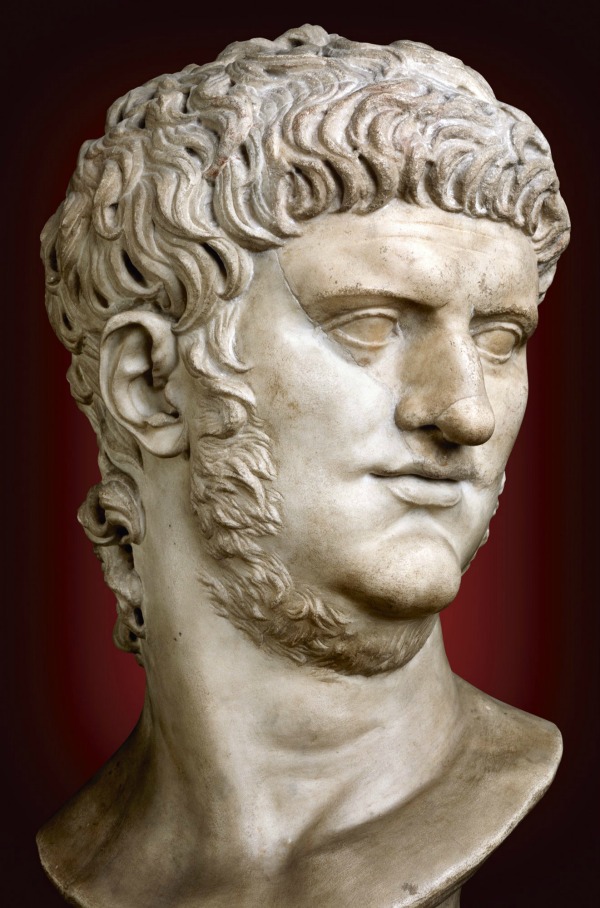
Let’s Talk Nero…
I didn’t know too much about Nero until somewhat recently. I knew he was a madman and an emperor, but not much more. During a visit to his golden palace in Rome (you can read about it in the Underground Rome section of my new book Glam Italia! 101 Fabulous Things To Do In Rome, available on Amazon.com) I was asking my guide, an archaeologist from the site, some questions about him. She pulled me to the side and very emphatically told me Everything you know about Nero is wrong! I am down here with him every day. I know him! They have lied about him and I know the truth.
Which is why I say I didn’t know too much about him until then. It would appear the senate changed the stories of more than one emperor once he died, so maybe we will never know the full truth, but her urgency got me interested in Nero and I plan on tracking her down when I get back to Rome to get the next part of the story.
Nero was the last emperor of the Julio-Claudian dynasty. He was born December 15 in 37 A.D and died June 9th in 68 A.D at the age of 30. He ruled the empire for 13 years and 8 months.
A Guy With Mommy Issues…
Nero’s mother, Agrippina the Younger was an interesting character. He was adopted by his great uncle Claudius and became the her and successor upon Claudius’ death. Agrippina is thought to have had a hand in the death of Claudius and in Nero’s nomination to be emperor. Apparently she dominated his early life and weighed heavily on all of his decisions a.k.a. controlling mother/stage mom. Five years into his reign he had her murdered.
… And A Guy With Many Wives
The story of Nero’s marriages is intriguing by itself. First he married his step sister Claudia Octavia, daughter of Emperor Claudius.
Claudia Octavia
It was a very unhappy marriage (because he was nuts) and he tried to strangle her on more than one occasion. While married to her he had many affairs including one with Poppaea Sabina, the wife of his friend Ortho.
Poppaea Sabina
Poppaea divorced Ortho and became pregnant with Nero’s child,
which in turn prompted Nero to divorce Claudia and banish her to Campania. The
baby died at 4 months old.
Claudia complained about her banishment, so Nero had her maids
tortured. The people of Rome like Claudia and marched in the streets to have
her returned to them, which scared Nero so he not only had her brutally
murdered but also had her head chopped off and sent to Poppaea.
Nero and Poppaea had a tumultuous relationship but it would
seem that she was his favorite wife, even though he ended up killing her too.
In the summer of 65 A.D Nero kicked a pregnant Poppaea in the belly, killing
both her and the child. After her death he went into deep mourning.
Statilia Messalina
While married to Poppaea Sabina Nero had been having an affair
with another married woman, Statilia Messalina. When Poppaea died in 65 A.D
Statilia’s husband was forced to commit suicide so that Nero could marry her.
And then things got even crazier.
In sometime around 66 A.D-67 A.D Nero also married a young boy
called Sporus, who bore a remarkable resemblance to Poppaea. Nero had Sporus
castrated and paraded him around dressed in the clothing of a Roman Empress,
and called him Lady, Empress, Mistress, and Poppaea. It is thought that he used
his marriage to Sporus as a way to assuage his guilt for killing Poppaea.
Sporus
After Nero’s death Sporus was then taken on by Praetorian
Guard Prefect Nymphilius Sabinus who treated him as a wife and also called him
Poppaea. Nymphilius wound up getting killed by his guardsmen, and the story got
even crazier when in 69 A.D Poppaea’s ex husband Ortho, who now became emperor
albeit for only 3 months, then took up with Sporus!
Sporus ended up committing suicide to avoid being used as a
victim in a gladiator show. He was probably not even 20 years old at the time.
But back to the wives of Nero, there was actually one more. Back in 64 A.D after a series of banquets during the Saturnalia Nero married one of his former slaves, a freedman named Pythagorus. Except this time Nero was the bride and Pythagorus the groom. Nero even wore a bridal veil! After the ceremony the witnesses had to watch the consummation of the marriage too.
Nero’s time as emperor is generally associated with tyranny,
compulsive behavior and extravagance. (As well as lunacy). Many historians
believe he started the great fire of Rome in 64 A.D to clear the way for him to
build his gigantic pleasure palace, the Domus Aurea. Apparently he blamed
Christians for the fire and had them burned alive.
There are modern historians however who believe the ancient sources who wrote about Nero were unreliable. The archaeologist I went through Domus Aurea with is convinced that the history we know of Nero is in fact based on lies and hatred, not the truth.
The Domus Transitoria
Nero’s first palace, the Domus Tansitoria is now open to the
public after a 10 year renovation.
The stairway down to Domus Transitoria
Transitoria was a lavish palace decorated with marble, inlaid
marble, porphyry, mother of pearl, frescoes and mosaics, dating back to 54 A.D.
It connected the Palatine Hill with the Esquiline Hill, which is how it got its
name. It was built partially underground to help Nero beat the Roman heat.
Most of the Domus Transitoria was burned to the ground during the great fire of Rome in 64 A.D. The ruins were discovered, robbed and looted during the 18th century.
2000 year old frescoes inside Domus Transitoria
What remained has been restored, so you can see the floors, frescoes and structure. One of the best preserved areas of the complex contains the 50 communal toilets thought to have been used by the slaves and workers, almost 2000 years ago.
You can take a guided tour of Domus Transitoria, but the tours
are for small groups only, around 12 total. There is new lighting down there,
so you are not wandering in twilight. There is also a virtual reality component
to the tour. This is something that Rome is doing so brilliantly, the
multimedia and V.R. components to the newer tours are just sensational.
Domus Transitoria is open Friday – Monday and is part of the new SUPER Foro-Palatino ticket. Check the website for more details and ticket options.
Bonus Content
Would you like to enjoy a cold prosecco with a mesmerizing view while in Rome? I have created a downloadable PDF of the Best Rooftop Bars In Rome. Each of these fabulous spots is right in the heart of the city and easy to get to, especially after a long day of sightseeing! Download your PDF here
If I were to ask you who is the most famous Roman of all time, I can pretty much guarantee you would answer Julius Caesar. And I think you would be right. He was the catalyst that moved the Republic to the Empire. His life story and achievements are incredible. He was a great politician, a great military man, and by all accounts a great man. He was a man of the people, he loved them and they loved him right back.
Caesar’s Story (The Short Version…)
Julius Caesar was born in 100 B.C, into a
family that was noble but broke. He grew up around middle class and poor people,
and as such could identify more with the common man than the upper class.
His early years read like a wild adventure,
hiding from the bad guys who were out to kill him, living a life on the run. At
one point he was captured by pirates and ransomed, and then once freed he
turned around, attacked those same pirates, got the ransom money back and then
crucified them all!
Caesar was an accomplished military man and
he fought for the poor and the landless against the members of his own class,
which endeared him to the citizens of Rome. After years of fighting and civil
wars he eventually became the leader of Rome
Unlike
his predecessors he wasn’t about bloody purges and savagery, instead was a
really good leader. He brought about peace, pardoned enemies instead of
crushing them, and always, always maintained a fantastic relationship with the
people of Rome. They loved him.
But the Senate didn’t. He was blowing their game on enriching themselves at the expense of the poor, and he held far too much power. So they decided to assassinate him.
On
the 15th of March 44 B.C he was to attend a meeting of the senate.
His friends had warned him not to go, a psychic warned him he would die on the
Ides of March, his wife Calpurnia had a nightmare that he would be killed, and
on top of all of these he woke up having one of his dizzy spells. So he sent a
message that he wouldn’t be coming.
He was due to head out on a military mission the next day and the senate worried he would come back an even bigger hero than he already was, so in desperation they decided to send someone he trusted to get him, Decimus Brutus. Caesar loved Decimus like a son, so away they went together, arm in arm.
Murder In The Curia
The Senate house had been damaged by fire
so the meeting was held in the Curia (a senate meeting room) in the Teatro
Pompeo.
The meeting began and suddenly dozens of senators pulled daggers from their togas and set upon Julius Caesar in a stabbing frenzy. When it was done everyone fled, leaving him to bleed to death alone on the cold marble floor.
The senators thought they had liberated the
republic. They saw themselves as heroes. The people saw otherwise. Enraged that
their beloved leader had been taken from them they took to the streets and
rioted. The conspirators who killed Caesar locked themselves inside their homes
or fled.
It got worse too. Julius Caesar’s
funeral took place in the Forum and the masses came to pay homage. Remember the
people of Rome loved him. Their fury at his murder was at boiling point when Marc
Antony took advantage of an incredible opportunity.
Friends, Romans, Countrymen…
Marlon Brando as Mark Antony
He got up in front of the people and spoke of all the great things beloved Caesar had done for them. A politician to the core he got them whipped into hysteria . Then he held up Caesar’s blood stained toga and pointed out all the stab wounds.
Caesar’s Will
To
top it all off, right when the powder keg that was the crowd was about to
explode, Marc Antony read them Julius Caesar’s will.
Caesar the great had bequeathed his estates, his gardens, his art collections (which were pretty sizable) and a huge sum of money, to the people of Rome. His people. The people he loved more than anything. For their benefit and for their enrichment. What could possibly show the people of Rome more clearly that he wasn’t the oppressor the senate accused him of being?? This proved beyond a shadow of a doubt that his assassination had been a theft. They had been robbed of this great man. The crowd (literally) went wild.
The crowds raged through the Forum smashing
everything they could and throwing anything that could be burned onto the
funeral pyre. Fire tore through the Forum and the mob went wild.
The remains of Julius Caesar’s Temple in the Roman Forum
So the Senators plan back fired. Instead of strengthening the Republic, this destroyed it. Caesar had named Octavian as his successor, and he went on to amass more power than anyone ever had before, created the Empire and renamed himself Augustus.
The Anniversary of Caesar’s Death
Every year on the anniversary of Julius Caesar’s death, March 15th, also known as the Ides of March, there are celebrations in Rome. There is a marathon in his name, cultural events happen across the city, there is a re-enactment of his death at the Teatro Pompeo, and flowers are laid at the Temple of Caesar at the remains of his funeral pyre.
One of the things I love to do when I’m in Italy is check out any festivals happening nearby. There are multiple festivals that take place in Italy every March. If you are on the Private Members List you will have a list of my favorites in your inbox. If you are not on the Private Members List and would like to get all the extra information to help you plan your trip to Italy you can join it HERE.
My New Book
I have a new book coming soon! Glam Italia! 101 Fabulous Things To Do In Rome takes you through (more than) 101 different things to see and do in Rome that are not on the regular tourist radar. I don’t talk about the Colosseum, the Vatican, The Trevi Fountain or the Spanish Steps, because A) you already know about them and B) they are always full of tourists.
Most
people don’t realize that Rome is full to bursting with hundreds of really
amazing things to see, most of which are only a couple of minutes walk from the
big attractions. Each of these come with stories that range from intriguing to
hilarious, and give you an entirely different perspective on what you’re
looking at.
This
book not only tells you about some of these places, but also tells you what’s
nearby, so you can see where to slot some of them into your existing Rome
itinerary.
From
Ancient Rome to Underground Rome, amazing churches to the best markets, from where
to watch the sunset over the Eternal City to where to find the Caravaggios, from
street foods you have to try to where to find the ghosts of Rome, the book is
packed with fantastic information designed to turn your visit into the trip of
a lifetime, and make you fall in love with Rome the way I have.
Join the list for news about the book release and discounted pricing HERE