Traveling To Venice ~ The Lagoon Islands

If you have a few days in Venice 

take the time to explore the northern lagoon islands for a completely different Venetian experience.

Venice-Lagoon-islands-Murano
Murano via charmingitaly.com

“That a silk robed, clove scented princess named Venice could be sprung from a swamp was a mad fancy…”
~ Marlena di Blasi


Start with a trip to the glass blowing island of Murano.
Don’t take a “free” boat trip from the city center – these are paid for by the glass factories and you will be under significant pressure to buy glass. Also this is often a one way free ticket so you may have to find your own way home.
Instead take a vaporetto across, bypass the Colonna and Faro stops, and get off at either Museo or Venier.

Murano has been the home of Venetian glass blowing since1291. when the wooden buildings of central Venice were considered to be at too great of a fire risk so the furnaces were moved across the water. The population of 5000 swells by day with glass factory workers coming over from the mainland. In a centuries old tradition apprentices learn flamework, twisting and blowing from master craftsmen. 

Glass-Blowing-Demonstartion-Murano-Italy
Take in a glass blowing demonstration in Murano
image courtesy of missglamdan.com

Take a factory tour and watch a glass blowing demonstration and find out more about the history of Venetian glass at the Museo dell’ Arte Vetraria.

Make sure you allow yourself time to walk around Murano’s town center and get a feel for this wonderful place. Explore it’s canal system (including it’s own Grand Canal), the floating market, and the mosaic floor of the 12th century Basilica dei Santi Maria e Donato. Another must see is the parish church San Pietro Martire with its two beautiful Giovanni Bellini paintings.

Murano is lovely to stroll around. If you are buying glass avoid the cheapie tourist glass – it’s unlikely to have been made here. Choose a reputable showroom and get the real thing.

Burano

From Murano take a vaporetto to Burano, the lace island.

Venice-Lagoon-Islands-Burano
Beautiful Burano
image courtesy of www.trekearth.com

For centuries Burano has thrived as a fishing community. While the men would be out at sea fishing their women would stay home making lace. The men would paint their house bright shades of blue or red or gold so that they could spot their home from the sea when they were fishing. Consequently the island is a riot of color with canals full of fishing boats and nets.

Burano-Venice-Homes
Burano
image courtesy of www.gnixus.wordpress.com

Lace making started here in the 15th century. The Burano-point and the Venetian-point evolved and the lace grew in demand all over Europe. A lace school was established in 1870 to keep the lace making skills passing on to younger generations. It still exists, you can go there to see lace being made, and it also houses the lace museum.

Burano is conntected to the smaller neighboring island of Mazzorbo by a bridge. Its lovely to stroll around, and from the  bridge you have a wonderful view of Venice.

A word to the wise: Burano lace is very expensive. You can find it in the more expensive stores on the island. The endless stalls and vendors on the streets selling cheap lace import it all from China, so it’s not legit.


Torcello


Torcello-Venice-Lagoon-Islands
Torcello, the ancient mother of Venice
image courtesy of www.locandacipriani.com

“Across the marshes (…) and with their reeds bent by the heavy north wind, he saw the squared tower of the church at                                                Torcello and the high campanile of Burano beyond it. “
                                   (Ernest Hemingway “Across the River and into the Trees”)


Quiet, sparcely populated Torcello is Venice’s oldest continously populated region, was Venice’s earliest settlement, settled in the 5th century and at one point in the 1300s housing a population of more than  20 000. 

In the 1200s the lagoon around Torcello slowly became a swamp, attracting malaria carrying mosquitos. As the Rialto area developed Torcello’s inhabitants fled to Venice leaving behind an 11th century church, a great basilica, palaces and houses that decayed, and canals that silted up. Today there is only one muddy canal running from the pontile to the piazza.

The Basilica di Santa Maria Assunta was first built in 638 and is famous for it’s remarkable mosaics which date back to the 12th and 13th centuries. 

Mosaic-Of-Mary-In-The- Apse-of-Basilica-Santa-Maria-Assunta-Torcello
The spectacular mosaic of Mary in the apse of Basilica Santa Maria Assunta, Torcello

The superbly detailed Last Judgement on the back wall is well worth visiting. (Make sure you check out the devils pushing the damned into hell.) 

Basilica-Santa-Maria-Assunta-Torcello-Mosiacs-Last-Judgement

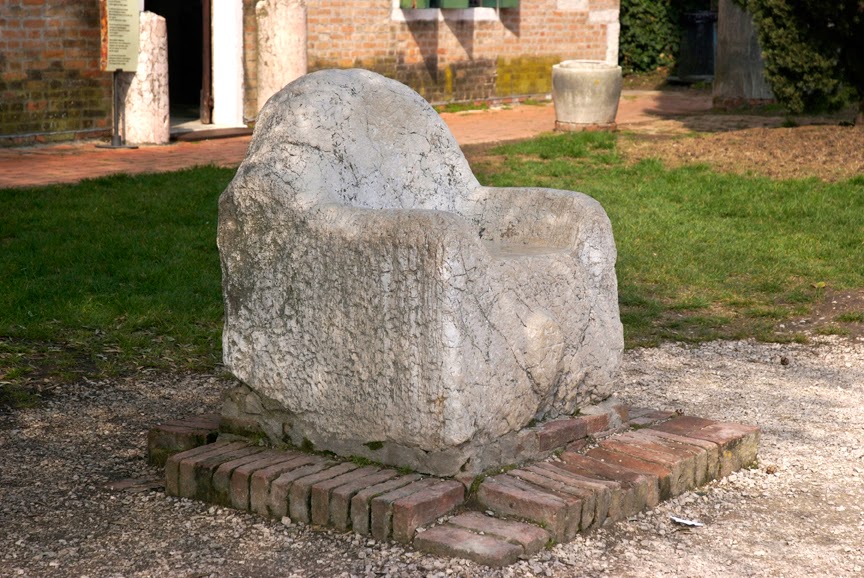
While you are there go next door to the 11th century Byzantine church Santa Fosca, and also go sit in the (strangely comfortable) “Attila’s Throne” concrete chair in the piazza. Legend dates it to the 5th century leader of the Huns, and it is said to be good luck to sit in it.
Venice-Torcello-Attila's-Throne
Attila’s Throne, Torcello.

Check out my other travel posts about Venice here
Read aboout the Dorsoduro here
Read about Ca’ d’ Oro here


If you have enjoyed this blogpost, please share it on your social media! I would love to hear about your Venice travels in the comment section.

Venice ~ Ca’ D’Oro

One of my dearest friends is getting ready to go on her first ever trip to Italy. 
I wanted to share with her some of the wealth of information I have on Italy, from years of traveling there and from being completely in love with the country. I started writing down ideas and notes for her so that she wouldn’t forget any of it, and then other people started asking for copies. 
In the end I decided to put some of my notes into blogposts so that I can hopefully share the magic of Italy with more people.
This post is part of a larger story on Venice. If you landed here independently of that post, click here to read it – you’ll find some great tips for traveling in and experiencing the absolute magnificence of beautiful Venice.


Ca’ D’Oro


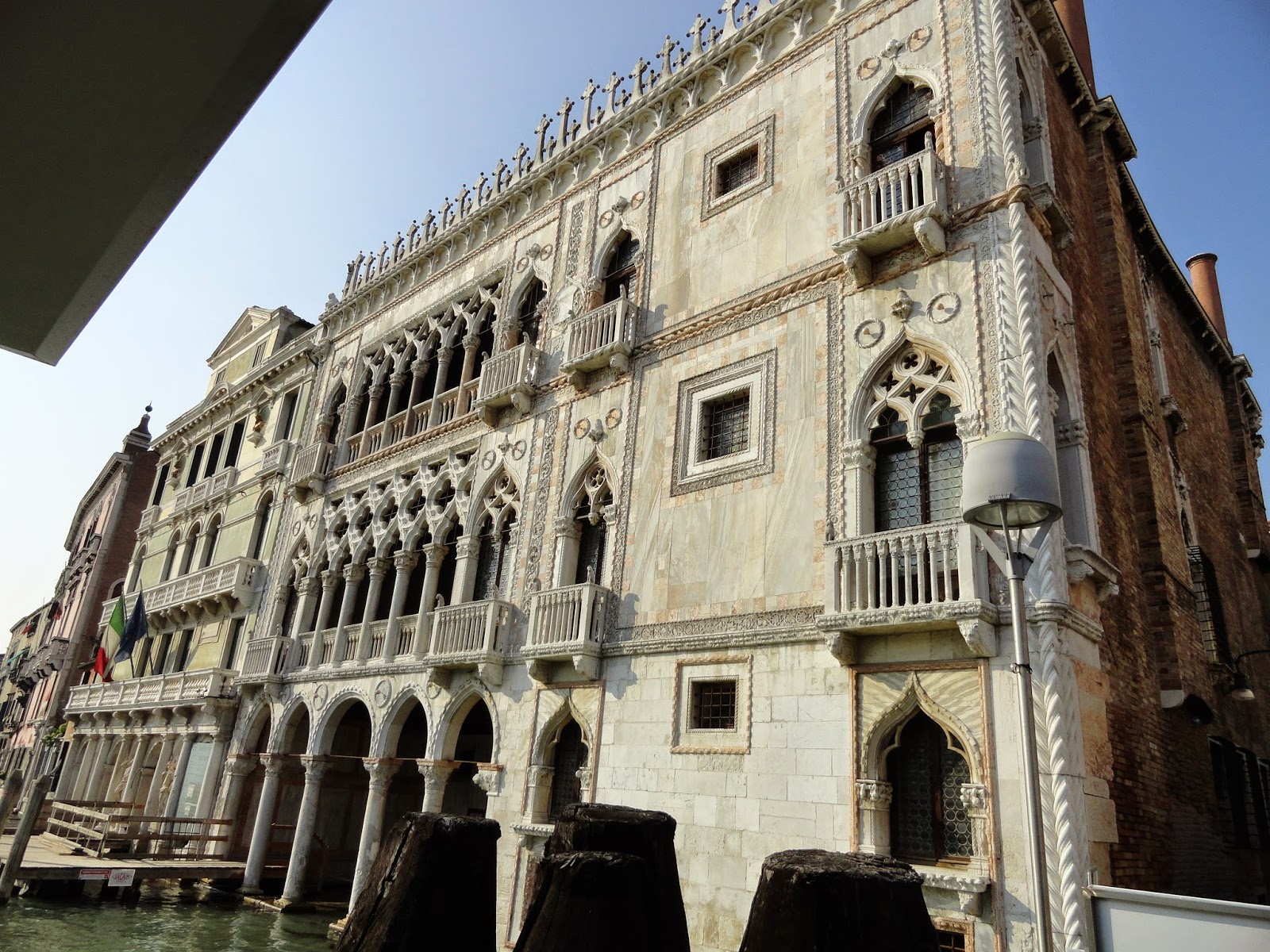
the exquisite Ca’ D’Oro, Venice

Everytime I’m in Venice I end up making my way to the fabulous Ca’ D’Oro in Cannaregio.
Literally translated it means house of gold.

The Grand Canal is lined with spectacular buildings, each with an intriguing story, and to me, this is one of the best.
Ca’ d’ Oro is one of the canal’s most flamboyant examples of Venetian Gothic. In 1420, during an era when Venice was the trade capital of the world, perhaps the richest city in the world, merchant Marino Contarini commissioned the renovation of this grand palazzo, with it’s pinnacles, marble and gothic tracery, influenced by the Doge’s Palace. (as only the Doge could have a “palace” the other palazzi or palaces are referred to as a casa, or house, which is then abbreviated to Ca’)
The home’s original name is Santa Sophia, and came to him via marriage.
Renovation is thought to have started around 1421 and completed around 1431. In an egoist display of affluence the facade was decorated with the most expensive pigments available – ultramarine, vermillion and gold leaf.
When the sun would hit the facade there would be an explosion of gold radiating across the canal.
If you look at Ca’ D’Oro from the opposite bank (near the Rialto) you can only imagine how sensational this must have been!

Contadini died in 1441, after which St Sophia/Ca’ D’Oro began slipping into decline.
Stripped of it’s golden facade the palazzo changed hands many times, eventually becoming semi derelict.

Ca'D'Oro-Venice
Ca’ D’Oro, via www.trekearth.com

It’s worst moment came at the hands of a Russian in 1847. Prince Troubetskoy bought the house for his mistress Maria Taglioni, and then promptly ripped off the marble facade, tore out the open staircase, sold the original wellhead, and otherwise desecrated this incredible property.
Art critic John Ruskin watched in horror, and tried to sketch as much of it as possible before it was too late.
Rescue came in the form of Baron Franchetti, an avid art collector, who bought and restored the property, including the staircase and the well, and then filled it with his treasures.
In 1916 he donated it to the state, full of his collections of paintings, sculptures, rare coins, and now it is an art museum.

Ca'D'Oro-Venice
View of the facade of Ca’D’Oro from the Vaporetto stop

From the ground floor you can look inside and see how these palazzi functioned. The bottom level was used for warehousing, but also had a lovely courtyard from which the staircase lead to the 2nd and 3rd floors where the living happened.

Courtyard-Well-Ca'D'Oro-Venice
The well in the courtyard at Ca’D’oro

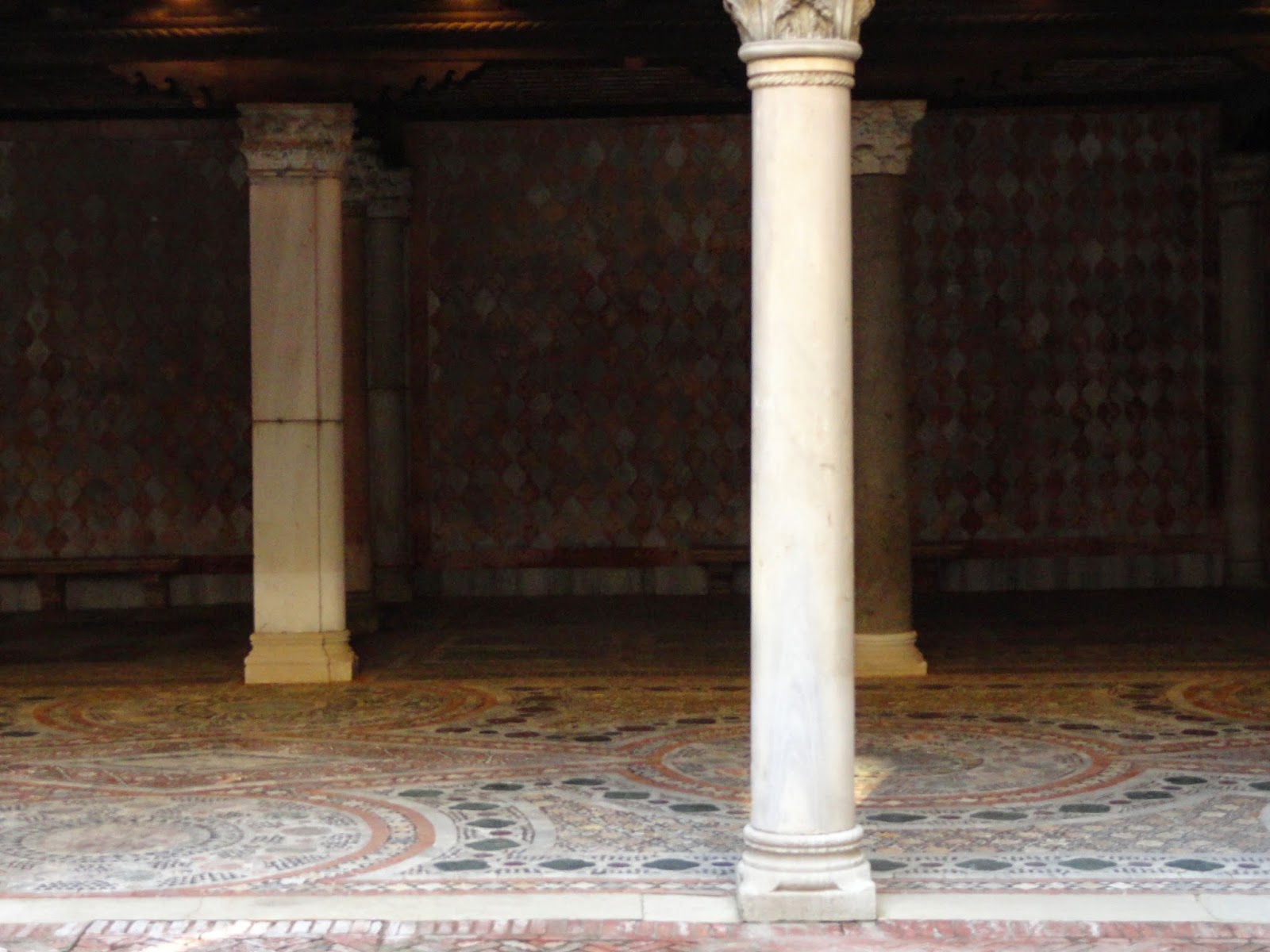
Courtyard-Mosaics-Ca'D'Oro-Venice
Mosaic floors and tiled walls in the courtyard of Ca’ D’Oro. These floors get flooded every year.

Both of these upper floors have covered loggias from which you can get a wonderful view of the canal.
If you go in the morning you can watch the daily business of the canal’s delivery traffic – remember everything gets from point A to point B in Venice by boat.
With 90% of the tourist traffic staying in the vicinity of Piazza san Marco, you can walk freely and unimpeded through Ca D’Oro, at times having a private viewing of the incredible art collection.
The mosaic floors are noteworthy, and art buffs should make a point of visiting the painting of San Sebastian by Andrea Mantegna, which was painted toward the end of the artist’s life.

San-Sebastian-Andrea-Mantegna-Ca-D'Oro-Venice
Andrea Mantegna’s Saint Sebastian, Ca’ D’Oro, Venice

Walk up the alleyway beside Ca’ D’Oro you will arrive at Strada Nuova, a charming street full of restaurants and bars, (a great place to stop for a spritz and some cicheti on your way to the train station if you are just spending the day in Venice).

Read about exploring Venice here
Read about the amazing Dorsoduro here
Read about exploring the Lagoon Islands here


If you have enjoyed this post, please give me some feedback in the comments section below, and also share it on your social media.

Why You Need To Explore The Beautiful Dorsoduro In Venice

One of my favorite sestieri (neighborhoods) in Venice is its backbone – the beautiful
Dorsoduro. From here you can not only get perfect views of San Marco across the Grand Canal, but you can also wander through its picturesque calle and rios (little streets and mini canals) without being stuck in a crush of tourists, and there is so much to see and do!

Venice-Dorsoduro
view of the Dorsoduro, Venice

To me this is Venice’s most gorgeous neighborhood, resplendent with historic buildings, amazing churches, picturesque little squares and canals. Walking around in the Dorsoduro you get the concept of what Venice is
really all about. It is just the most wonderful experience, so incredibly beautiful, and compared to the manic tourist explosion surrounding Piazza San Marco just across the grand Canal, it even feels quite peaceful.

View ofthe Dorsoduro along the Grand Canal to Santa Maria della Salute

There are major art attractions such as the Galleria dell’ Accademia and the Peggy Guggenheim Collection, and plenty of beautiful churches to visit. In fcat one of Venice’s most iconographic churches, the huge, white Santa Maria della Salute is in Dorsoduro, looking across the Grand Canal to San Marco and the Doge’s palace.

Zattere selfie. This was a June afternoon in 2018 when 5 cruise ships were in and Venice was packed with tourists. But not here in Dorsoduro – it was totally mellow. Right after this photo I had a prosecco in the bar under the white tents behind me, enjoying the view without the crowds.

On the other side the wide, restaurant filled fondamenta of the Zattere stretches the length of Dorsoduro. It has endless options for lovely places to sit along the waterfront enjoying an apertivo with a view of the Giudecca island and the canal in between. And unlike San Marco it is calm, peaceful and doesn’t have crowds.

Ca’ Rezzonico

One of my favorite museum palaces on the Dorsoduro is the majestic Ca’ Rezzonico. 

Ca-Rezzonico-Dorsoduro-Venice
Ca’ Rezzonico, Dorsoduro Venice

This luxurious palazzo built in 1667 for the Bon family is now a “house museum”.
When the Bon family ran out of money the palazzo was bought by the newly rich banking family, the Rezzonicos. At that time the building was two separate homes, both in complete disrepair. The Rezzonicos bankrolled a glorious restoration that included Tiepolo frescoes and Flemish tapestries, gilt and pilasters and a level of opulence that is hard to wrap your mind around!
This mind bendingly ostentatious palazzo is not only a museum, it gives you a peek into the lavish life of upper class 18th century Venice.

Restored again in the 1990’s Ca’ Rezzonico is known as “the museum of 18th century Venice”, 
famous for it’s interior decor. From the ground floor the graceful staircase sweeps you up to the piano nobile with its huge ballroom, so ornate it quite literally stops you in your tracks. 

Ca-Rezzonico-Ballroom-Dorsoduro-Venice
The ballroom at Ca Rezzonico, Dorsoduro Venice 

 The chandeliers! The ceilings! During the never ending cycles of parties and mad displays of wealth in 18th century Venice, this was the ultimate party room, the place you absoltuely wanted to both be invited and be seen. Standing in this incredible ballroom you begin to understand the vastness of the wealth and power that was centered in Venice for centuries. And it is just overwhelming.

Ca-Rezzonico-Ballroom-Dorsoduro-Venice
The ballroom at Ca Rezzonico, Dorsoduro Venice 

Meandering through the staterooms you have to remind yourself that this wasn’t a royal palace, it was a private
home. The opulence doesn’t stop there – two more floors hold artworks including Tiepolos and the only Canaletto’s in Venice.

Before you leave make sure you visit the lovely courtyard garden.

A Campo (Piazza) You Musn’t Miss

Another must see in the Dorsoduro is Campo Santa Margherita. 

Campo-Santa-Margherita-Dorsoduro-Venice
Campo Santa Margherita, Dorsoduro Venice
Campo-Santa-Margherita-Dorsoduro-Venice
Campo Santa Margherita, Dorsoduro Venice

This is the neighborhood’s main square, and may be the liveliest in Venice. By day it is busy with shoppers, locals, families, the daily market, interesting shops, bars and restaurants. It is a lovely place to sit on tree shaded benches and watch local life taking place. By night this is the social center of the city. While most of Venice goes quiet, Campo Santa Margherita is where the nightlife happens, populated with students from the nearby university, and all the bright young things from every part of the city. The bars and restaurants are fun, and it is most definitely a great night out.

Make sure you check out my other posts in this series on Venice:
Read about The Lagoon Islands here
Read about Ca’ d ‘Oro here
Read about Traveling in Venice here

Experience more of Venice without the huge tourist crowds with my free Secret Venice PDF. Discover 10 places you won’t want to miss, including my favorite spot to enjoy a madly chic aperitivo at the end of the day! Get your free Secret Venice PDF here

Verified by ExactMetrics