
Should You Fly First Class -Tips You Need To Know

When you are planning a trip involving airline travel one consideration is which class to book your flight. Most of us end up booking economy tickets, yet dream about riding in the front of the plane in the luxury and decadence of first class.

American Airlines First Class

If you are in the financial bracket that can afford first class all the time this post may not be for you. But if like me you typically travel on a budget, here are 8 times you may want to consider booking your flight in Business/First class.

Domestic Flights

Personally I don’t bother with paying the extra (or heaven forbid, wasting miles) on flying first class on domestic flights. Here in the U.S. most domestic flights are no longer than 5 or 5 1/2 hours. For the extra cost of first class you get a slightly bigger seat (1.5x) get to board early and get a free glass of crappy wine or non-top shelf spirits. For the cost differential you might as well just buy yourself a couple of drinks and just ride in the main cabin.

International Flights

My theory with international flights is that if the flight is less than 8 hours, for example Chicago to Dublin, which is 7 hours, it’s not worth the extra cost. If a flight is 8 hours or more it can be a really great option to turn left when you are boarding!

champgne in first class on al italia
“Ms Cooke, can I interest you in a pre-flight glass of wine?”
“Actually, it just so happens you can…”

Some of the benefits flying Business or First class internationally include extra luggage allowance, use of the club lounge in the airport (which can be worth its weight in gold), early boarding – there are an average of 300 people getting on this flight so it helps to get ahead of the crush, and in most cases have a separate entrance onto the plane.

business class menu on alitalia flight from LAX to Rome
The food was actually pretty fabulous

You get greeted by name, escorted to your seat, your coat is hung up for you. There are pre-flight champagne, a la carte menus and you eat from real plates, have real cups and glasses, and best of all you have a wide seat that lies down flat so you can sleep. It’s fabulous!

International business class food on American Airlines
Business class appetizer on American Airlines flight from Paris

Related Post: 10 Best Tips To Help You Sleep On A Plane

When Should You Fly First Class?

Let me preface this by saying I am a single mom so don’t normally factor first or business class flights into my travel budget.

I generally find that most international flights seem to have a hybrid first/business class instead of the old school economy, business and first class configuration. When I talk about first class for the most part that is the first/business combo.

I tend to buy economy tickets but by using the tips and tactics I tell you about in my book Glam Italia! How To Travel Italy: Secrets To Glamorous Travel (On A Not So Glamorous Budget) I get upgraded a lot. Not quite half the time I fly, but close to it. I doubt I will ever spend $6000 on a business class ticket, but I do sometimes pay for an upgrade – I just don’t pay much for it.

But let’s look at 8 times you might want to fly first class

1. When It Is A Really Long Flight

I have a personal (budget) rule that I won’t pay to upgrade to business class on any flight that is less than 8 hours. On international flights anything under 8 hours is in my mind not worth the extra cost – I’ll keep the money for shopping.

However when you are flying 8 hours or more, I think it is really worthwhile, especially if you get a good deal on your ticket. Flying from Los Angeles to Australia or to the main hubs in Asia can take 14 to 16 hours, with L.A – Asia being the hardest route on your body for jet lag. I do my best to get upgraded or find a deal on a business or first class seat on those flights.

2. When You Have To Work

If you have to work during the flight, be that prep for a meeting or get a paper written etc, that business class seat can be a Godsend. Not only do you have the benefit of a good sleep and arriving well rested, but also your seat table converts into a really good desk space too.

Business class American Airlines Barcelona to JFK
The table on the seat across from mine on a flight from Barcelona. Plenty big enough to use as a desk and get work done during the flight. Or to line up drinks…

One of the flights to Milan that I flew up front on had seats that converted into office style leather chairs that turned to face the window, where the side panel turned into a perfect desk space. It was really cool, and if you were working (I wasn’t) would have been incredibly functional.

Want to know how I fly around the world for free? Read this blog post where I explain it all!

3. When It Is A Special Occasion

Another great time to splurge and fly first class/business class is when it is a special occasion. Honeymoons, anniversaries, major birthdays all are great opportunities or excuses to turn left when you board that international flight!

Corinna Bs World first class American Airlines
Flying home from Barcelona in Business/First Class on American Airlines on a birthday trip.

4. When You Are Exhausted

When you arrive at the airport completely exhausted, flying business class or first class can be a game changer. Having the ability to lie flat in a comfortable bed-chair with a fluffy pillow and a comforter in the quiet that happens in front of the engines (no annoying engine hum to keep you awake) is just fantastic.
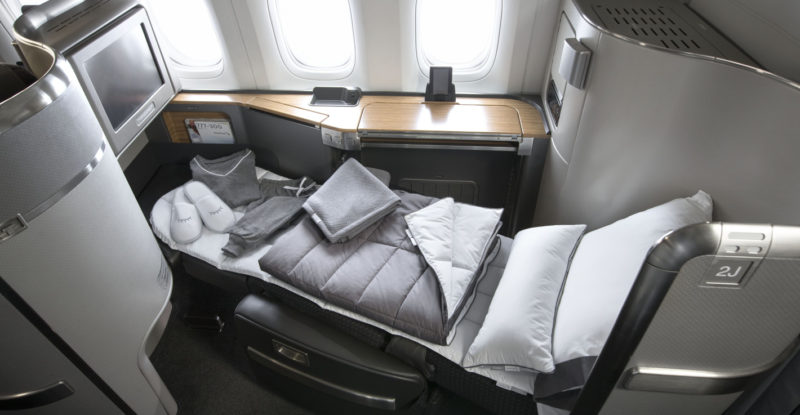
First class seat on American Airlines international flight

A couple of years ago I arrived at the airport in Los Angeles beyond exhausted after having worked 7 days per week for weeks on end. I was flying to Paris to work and wasn’t looking forward to being in a cramped seat for 12 hours. I was upgraded to business/first class, and although I barely slept because it was too fabulous to miss one minute of, I still arrived at Charles de Gaulle feeling rested and ready to take on the world!

Want to know how I get upgraded so often on international flights? I go into detail on how I do it in my book Glam Italia! How To Travel Italy: Secrets To Glamorous Travel (On A Not So Glamorous Budget)

5. When You Need Pampering

Sometimes life gets difficult and you just need pampering. (I pretty much always feel like I need pampering) If I had the disposable income available I would fly up front all the time, but of course I don’t and can’t. But if you need or feel like being pampered in the air and your budget allows for it, try flying business/first class at least once in your life.

6. When Jet Lag and DVT Are A Real Concern

Jet lag happens due to crossing multiple time zones flying east/west. You can’t get jet lag flying north/south. There are many factors that contribute to jet lag and travel fatigue but I sincerely believe that lack of comfort on long flights contributes to them. I have never deplaned from business/first class and felt anything less than fantastic. If you have to bop off that long international flight and roll into a garden party looking your most fabulous, this could be the answer!

RELATED POST: HOW TO BEAT JET LAG

DVT or Deep Vein Thrombosis is very, very serious. Also known as an economy class disorder, it doesn’t happen nearly as much in business class or first class. Basically DVT is deep vein blood clots that primarily occur in the lower legs, sometimes upper legs. Those clots can then dislodge and work their way into the lungs causing pulmonary embolism. DVT can be fatal.

I always recommend taking an aspirin before you fly to thin out your blood, (in case that actually works) and to wear compression socks or hose to keep pushing the blood and fluids up and stop them pooling in your lower extremities. Studies have shown that keeping the feet/legs elevated on long haul flights is a powerful remedy. If you are at risk for DVT and have a long flight coming up, getting an upgrade or buying a business class seat can be invaluable.

If that isn’t in you budget it is worth your while to pay for an exit row or bulkhead seat and once the seat belt sign has turned off put your carry on bag on the floor in front of you and rest your feet on it. Most Premium Economy seats have a bar that comes down below the seat in front of you to rest your feet on. When it comes to DVT you have to do whatever you can to avoid it.

7. When The Price Is Right

Sometimes you can get lucky and find deals where Business/First class doesn’t cost much more than economy. This is especially true on days that aren’t popular flight days. Always check the prices the consolidators have and click on their business and first class options as well as economy. Every so often you will find a flight that is priced too low for Business/First. When you see it, grab it!

Al Italia Business Class
An ottoman to put your feet up on (the seat lies out into a flat bed incorporating the ottoman) with a hotel pillow and fluffy comforter. Alitalia Business Class

8. When The Timing Is Right

Other times you can get lucky and find your way into an airline computer glitch. Should you find some ridiculously low fare, jump on it. If you don’t someone else will, or when you come back after thinking about it the airline will have already corrected it.

And sometimes the airline just makes mistakes. Last year I flew Los Angeles – Amsterdam – Rome. The airline emailed me and offered me an upgrade on the Amsterdam to Rome connection for $221. Normally I would have declined as it was a short flight, but I had to get through passport control in Amsterdam and back to the gate, and I figured a business class connection might help me. Somehow the airline’s computer messed up and instead of just putting me in seat 2A on the Amsterdam to Rome flight it put me in 2A all the way!

On top of that there was bad weather in Amsterdam and we had a four hour delay. The upgrade gave me entry into the club lounge in Amsterdam and then when my business class flight arrived into Rome too late for me to catch my train to Florence I was comped a hotel room for the night!

Keep your eye out for airline errors and take advantage of them.

Bonus

Does the thought of planning a trip or getting organized to leave on one feel a bit overwhelming or stressful? I have a set of Free Resources to help you plan, organize and get ready for your trip. These are the same travel planners, questionnaires and checklists I give to my Glam Italia Tour travelers. This is a set of PDF’s that you can use over and over. Get Your Free Resources HERE

Airplane Etiquette ~ What You Need To Know Before You Fly

flight attendants

Spend enough time on planes and you will be horrified at the way some other travelers behave. Most people however are unaware their behavior is offensive and would be embarrassed if they knew. Sitting next to someone doing any of the following things can ruin your flight, but not only do you not want to sit next to this person, you don’t want to be them!

With that in mind let’s look at some airplane etiquette items, to help you become the ideal traveler.

1. Take A Shower!

I don’t know why this even needs to be said, but for the love of God take a shower the morning you are flying! You may think you smell fine, but that musty smell people get when they haven’t showered is gross. Especially when you are trapped next to it on a long flight. Or any flight.

2. Use Deodorant

Again, really?? I had a lady argue with me about this on a travel forum recently. She said why bother when you will jut be sitting there next to strangers anyway? Here is why – B.O is gross. No one should have to smell your B.O on a flight.

3. Wear Clean Clothes

Even if you have been backpacking for 6 months you can find a basin, some water and some soap and at least wash a t-shirt and some undies a couple of days before you fly. Being stuck on a plane next to someone who is smelly is just plain awful, and unfair.

RELATED POST: HOW TO PACK A SUITCASE LIKE A PRO

4. Dress Appropriately

The first thing to think about is being comfortable and warm when you fly, but you also need to be appropriately dressed. Don’t have your boobs half hanging out, your belly out, short shorts etc. Do all of that at home by all means, but on a flight you need to think of others too.

I was stuck next to a girl in a crop top recently, and her belly rolls were all over the place, with her bare skin not only squishing into our shared armrest, but also flopping over into my seat space.

Some airlines won’t let you on if you are inappropriately dressed, others don’t care.

5. Don’t Pick Your Nose, Ears or Any Other Body Part.

This is just basic decent manners. If you need to get something out of your nose/ear/bandaid/other body part, go to the bathroom and do it there. It is so unbelievably gross to be stuck next to a picker.

RELATED POST: CREDIT CARD TIPS FOR INTERNATIONAL TRAVEL

6. No Manspreading.

Dudes, I get it – you want to spread your legs, claim someone else’s space, and draw attention to your crotch. But for God’s sake, cool it. Your space is what falls between the arm rests, nothing beyond that. So keep your leg out of the aisle and out of the person next to you’s space. It doesn’t make you look like an alpha male, it makes you look somewhere between insecure and rapey, especially if you are sitting next to a female.

manspreading.

I have exactly zero problem telling any dude to get his leg out of my space, but plenty of women get intimidated (which is probably why you do it) and won’t say anything. It’s not cool, so stop it.

7. Stay In Your Own Lane

Keep your body inside your seat. Your thighs don’t belong in my seat, your arms don’t belong there either. We all have paid for the space that lies between the armrests, so you need to keep all of you inside that space.

If you have a window or aisle seat you can lean to the side or adjust yourself to get comfortable. The person in the middle seat has nowhere to go so they get both armrests – it’s only fair.

Also, keep your hair out of other people’s business.

RELATED POST: 7 TRAVEL ACCESSORIES YOU CAN’T LEAVE HOME WITHOUT

8. Keep Your Feet On The Floor

bare feet on airplane
oh come onnnn!

You may be all up on your comfort game, but feet need to stay on the floor. Whether bare feet or in socks, it is never ok to put your feet up on the seats or on the armrests of the seat in front of you.

bare feet on airplane
this is rude, inconsiderate and plain gross.

9. Don’t Bring Smelly Food On Board

I’m a huge advocate of bringing healthy snacks when you fly. Sometimes you wind up bringing something more substantial on the plane with you, but just make sure its not smelly.

Tuna Salad Sandwich

Be considerate of others when bringing food on board. Tuna sandwiches, fast foods, Chinese food – smelly foods don’t only bother the people sitting immediately around you, but also stink out that entire section of the plane. The smell of McDonalds remnants is even more gross 3 hours into a flight than when you board with it.

While we are on food, also don’t bring messy foods that you can spill on someone. I have had starbucks tipped on me, and pho splashed on me. It’s not fair, don’t bring them on board.

10. Take Out Your Trash

trash left on airplane
On what planet is this considered acceptable??

Before landing the flight attendants always come by with trash bags to collect any refuse you have. Rather than dropping trash on the floor, put it in the bag. If you have been sticking dirty tissues etc in the seat back pocket, now is the time to trash them. Don’t leave a mess behind.

How To Deal With Electronic Border Serches

I travel all the time. I have Global Entry, yet just the thought of an electronic border search  although unlikely, is quite unnerving.

Learn about Global Entry here

Basically it involves you having to give all your passwords to the agent at border control so that they can check  your social media for subversive behavior. I suspect that if the USA gets aggressive with this to foreign travelers then other countries will get equally aggressive with Americans traveling abroad.

From what I understand, and correct me in the comment section if I am wrong, Al Quaeda, ISIS and co. encrypt their social media plots, so authorities wouldn’t find out about imminent attacks by checking cell phones anyway. I can agree that if they found someone with virulent anti-American rhetoric on their social media we shouldn’t let that person in, but how does it bode for the rest of us? Do we really want border control agents able to read all of our emails and social media and do whatever they want with them, or do we want to hold onto some measure of privacy?

You could of course get a burner phone to travel with, but for me that would be a gigantic hassle as my entire life runs through my iPhone. You could delete all social media apps from your phone and iPad, but that just looks like you have something to hide.

The whole issue is just creepy.

Afar.com sent me this article on the subject. If you are a traveler it is definitely worth reading.

How to Deal With Electronic Border Searches

Plus, what these more invasive searches mean for travel

man with cell phone

image via Afar.com

What to do if you’re asked to hand over your phone—and what these searches may mean for the future of travel

 Most people are sailing through passport control and customs just as they did before the inauguration. But for travelers from foreign countries—particularly those targeted by President Trump’s travel ban—and the unlucky few American citizens and legal residents who get pulled aside for what is known as “secondary inspection,” tales of electronic searches and disconcerting requests from border guards abound.

U.S. border agents have increasingly been demanding to search the electronic devices of some travelers entering and exiting the country and even requesting the passwords to their social media accounts. “The idea that it will become a concerted part of screening is very new,” says Alex Abdo, a senior staff attorney at the Knight First Amendment Institute at Columbia University.

So what does a U.S. citizen or legal resident need to know about returning to the United States from abroad—and flying domestically? Here, we break down the history of technology searches at the border, the likelihood of being searched when you travel, what you should do if you are pulled aside, and the best ways to protect your data at the border.
Electronic Searches Aren’t That Common—Yet

Phone and computer searches were happening before President Trump was elected, but privacy advocates worry they have since ramped up. Between October 2016 and March 2017, border agents searched the electronic devices of 14,993 arriving international travelers, according to newly released data from U.S. Customs and Border Protection (CBP), a nearly 79 percent increase from the same period a year earlier.

Searching electronic devices at the border is not a new tactic for CBP: The practice began a decade ago, in the waning years of George W. Bush’s presidency. The current policy, which allows for searches of “computers, disks, drives, tapes, mobile phones and other communication devices, cameras, music and other media players, and any other electronic or digital devices” has remained the same since 2009.

What has changed is how invasive those searches now are, thanks to the ubiquity of social media, smartphones, and mobile cloud storage, as well as advances in computer-assisted search methods for electronic devices. These days, most smartphones are continuously logged into their users’ email accounts and apps and contain everything from medical and financial records to cloud-stored archives of digital photos and social media messages.

At the moment, technology searches may affect only a tiny fraction of overall travelers entering the United States—0.008 percent within the past six months, according to CBP.


Allianz Travel Insurance

How to Protect Yourself and Your Data at U.S. Borders

When entering the country, travelers can protect their digital privacy in myriad ways—by traveling with data-free “burner” phones, deleting apps and sensitive data from devices, and encrypting their contents—but ultimately, if CBP officials request it, “You can’t refuse to turn over your physical device,” says Abdo. “They have clear authority to look at it.” He cautions against resisting an agent’s request to hand over a device: “We’ve seen some cases of people being physically subdued.”

U.S. citizens have not and cannot be prevented from entering the country for refusing to give up their passwords or unlocking their devices, but the issue is murkier for foreign visitors, who don’t have a right to come into the country and can be denied entry. “If you are a U.S. person, they eventually have to let you into the country, but they can make life inconvenient,” says Abdo. “They can detain you at the border for hours—there are cases where courts have approved of six-hour detention. They can take your device and hold onto it for five days.”

After a device is seized, CBP officials can take it off-site, try to crack its encryption, and copy its files and metadata, says Esha Bhandari, a staff attorney at the Speech, Privacy, and Technology Project of the American Civil Liberties Union. What happens to your copied data after the government has access to it? “They are supposed to decide within 21 days whether there is probable cause to keep that information,” Bhandari says. “But the notes CBP takes about you can be retained up to 75 years. If you verbally told someone your password, that could remain in a government database for a very long time.” If this happens to you, it is recommended that you change all of your passwords.

CBP officers may ask for your permission to search the content of your device. You do not have to grant it, Adbo says. “You should make clear you do not consent to searches of the devices” so as to not forfeit your legal rights. But this may very well result in your technology being taken from you for a temporary period.

Is Searching a U.S. Citizen’s Smartphone Legal?

Electronic device searches at the border exist in something of a legal gray area because the U.S. Supreme Court has not ruled on the issue. The border agency believes that device searches can be conducted without suspecting a person of a crime, or of being inadmissible, at U.S. ports of entry. But some legal experts dispute this reading of the law, saying that device searches at the border are so invasive they should require a warrant based on probable cause, as they are inside the country. “Most people think the writing’s on the wall,” says Abdo. “When it reaches the Supreme Court, they will decide these searches of U.S. persons’ devices are unconstitutional.”

The agency contends that it acts within the bounds of the law. “CBP’s searches of electronic devices is based on policy that ensures a disciplined, deliberate, and lawful approach, which affects less than one hundredth of one percent of travelers upon arrival in the U.S.,” says CBP headquarters branch chief Jennifer Gabris.

Get a Free 10-Day Look with Allianz Global Assistance, the world leader in travel insurance. Get a free quote now.

The Consequences of America’s Border Policy

The U.S. border policy is in flux right now, and technology searches may soon become more common at ports of entry, particularly for visa applicants. “Now we are hearing of proposals being floated by DHS [Department of Homeland Security] that they might ask for passwords for social media accounts for travelers to the U.S.,” says Bhandari. The proposed measures could see foreigners from all over the world being asked to turn over their devices, provide their social media passwords and financial records, and answer questions about their beliefs as a condition of arrival.

Of course, it’s not just foreign travelers to the United States who are affected by the uptick in technology searches at the border. The  valuable U.S. tourism industry, which supports 15.1 million jobs and benefits the U.S. economy to the tune of $2.1 trillion has already reported a sharp drop in foreign arrivals in 2017—which some industry groups attribute to the Trump administration’s immigration policy.

Requiring foreign travelers to disclose sensitive information such as their social media passwords could have far-reaching consequences for American travelers and legal residents. “This could lead to reciprocal requests from other countries,” warns Bhandari. “It would be chilling if this became the norm for international travel—for Americans to hand over their social media passwords when visiting other countries.”

In addition to privacy concerns, measures like this are also worrisome from a freedom of speech perspective. “Requiring foreign travelers to provide this information amounts to a test of ideology at the border,” Abdo says. “That should give anyone pause”—American citizens and foreigners alike.

“Whenever you engage in dragnet searches, you will inevitably pick up information that is useful,” he says. “If you drain the ocean, you’ll catch fish. But what is the proper balance between legitimate needs and the cost of the authority?”


Verified by ExactMetrics