The Best Of Barcelona – Gaudi’s Fantastic Sagrada Familia

Sagrada Familia Barcelona

No trip to Barcelona is complete without a visit to Antoni Gaudi’s temple to God, the Sagrada Familia.

The Sagrada Familia has to be one of the most intriguing cathedrals in all of Europe, and I am quite sure, the world. It is impossible to think of Barcelona without thinking of Gaudi or to think of Gaudi and not think of Barcelona. The two are intertwined for eternity.

Gaudi took over the design of the Sagrada Familia in 1883, knowing that his cathedral would not be completed during his lifetime. Construction initially was funded by donations, and stopped and started several times due both to lack of money, and wars. Now it is financed by ticket sales, so although it is a little pricey, your ticket actually is making a difference!

I am intrigued by the architects and workers who over the past decades have given their all to this project, knowing they wouldn’t be alive to see its completion. The current crew will hopefully see the cathedral finished, as the planned end date is in 2026.

RELATED POST: WHY YOU MUST VISIT LA BOCQUERIA MARKET IN BARCELONA

The Exterior

Tickets are timed at Sagrada Familia, with a half hour window to enter. I suggest ordering your tickets online, and then arriving a half hour prior so that you have time to walk the outer façade before getting in line to enter. If your ticket is for 11 – 11:30 am entry, get there at 10:30 am.

Sagrada Familia

Use the eastern façade, or nativity side as your starting point. The sculptures on the façade are in more traditional form and they tell the story of the birth of Christ.

Sagrada Familia Nativity Exterior

This side of the cathedral greets the rising sun, so as the sun comes up each day it lights up the birth of Christ. (If you are inside the cathedral in the morning the sun hitting the stained glass windows on the east side creates an explosion of blue light. It is magnificent!)

Sagrada Familia Stained Glass Windows

The southern façade is not yet finished, but will celebrate the glory of Jesus’ life.

The west side is the passion or death of Christ. This façade is quite modern and sparse, and the sculptures depicting the passion are intriguing.

Sagrada Familia Passion

They are all blockheads, making the entire façade quite jarring. (yet completely brilliant!)

Sagrada Familia Passion Sagrada Familia Passion

The Passion gets the setting sun each day, it hits the stained glass windows on this side of the building turning them into fire with their oranges and reds. If you are inside the cathedral in the late afternoon it is really spectacular, the stained glass windows representing an inferno.

Sagrada Familia Interior Sagrada Familia

Walking around the outside of the Sagrada Familia take note of the facades and how dark they look. This cathedral is a total play on light and space, and as such the more you focus on the exterior, the more the interior will blow your mind!

It was explained to me that Gaudi wanted the exterior of his cathedral to represent a forest, the towers being the trees. I don’t know if that is true or not, but now it’s stuck in my head and every time I look at it I see his forest!

There are a total of 18 towers, organized in the hierarchy of Christian symbolism. The center tower is dedicated to Christ, surrounded by the four towers representing the gospels. The tower above the apse will be his mother, the Virgin Mary, crowned with a star. The remaining 12 towers represent the apostles.

RELATED POST: BARCELONA CHRISTMAS TRADITIONS – WHAT EXACTLY IS CAGA TIO???

The structures create a sense of elevation with their pyramid-style layout. The 12 apostles circle the outer edges each at 100 meters tall, the gospels makeup the next layer of the pyramid at 135 meters tall and the tallest will be Jesus at 172.5 meters tall, making it one of the tallest religious buildings in the world. The height of the Jesus tower was to show Gaudi’s respect for the work of God which in his mind should never be superseded by man. The highest point in nature around Barcelona is Montjuic at 173 meters, so the Jesus tower is just shy of that height.

The Interior

When you walk inside it will completely take your breath away. The outside of the cathedral gives you no sense of how light and bright the interior is! If you have visited other cathedrals around Europe you will be familiar with their typically dark interiors, and you somewhat expect to see exactly that. The inside of Sagrada Familia is incredibly vertical and light and bright. Gaudi’s use of natural light is breathtaking. It is so incredibly modern and yet ethereal too.

Inside Sagrada Familia Sagrada Familia Interior

Colored light bounces off the stained glass, the soaring white towers feel like they are lifting you. Gaudi said that color was an expression of life, and this cathedral feels alive.

Sagrada Familia Interior

Christ is suspended from the ceiling, his crucifix hanging under an umbrella. The sight of it is disconcerting, jarring and yet also brilliant.

Sagrada Familia Cricifixion Sagrada Familia Christ

Next time I go to Sagrada Familia I need to have a guide explain every detail to me.

RELATED POST: SHOULD YOU BUY TRAVEL INSURANCE?


Gaudi

In order to understand the Sagrada Familia you first need to understand Gaudi, or at least know a little about him. He was one of the best known and most influential figures in the Modernisme movement, which took place from the late 1800s through the early 1900s. In school he excelled in geometry and mathematics, and entered the School of Architecture once he was 21, excelling in design, drawing and mathematical calculation. 5 years later after graduating he received his first architectural commission in 1978.

His reputation grew as did his commissions including the Casa Batllo, Casa Mila and Casa Calvet, then in 1883 he took over the design of the Sagrada Familia.

Gaudi’s work is highly recognizable, his style very distinctive. He lived via the three passions in his life: architecture, religion and nature. He thought about every tiny detail in his creations, infusing stained glass, ceramics, wrought iron and trencadis (wasted ceramic pieces) into his work. Rather than the strict, straight lines of traditional architecture, Gaudi’s ideas rolled and swelled like waves and took on forms in nature.

Initially when he took over the design of the Sagrada Familia Gaudi still worked on other projects, but in 1914 he abandoned all other work and just devoted himself to his religion and to his cathedral, living and working there the last 10 years of his life.

The Sagrada Familia has always been funded by donations, and toward the end of his life Gaudi was living like a homeless man, begging in the streets for money to go toward his church. In fact, when Gaudi was hit by a tram on his way to church in 1926 no one knew it was him, they thought it was a homeless man. As such he was sent to the hospital for the poor, where he died 3 days later. Gaudi is buried in the crypt of his cathedral, his most perfect resting place.

To get to the Sagrada Familia take the metro on the L5 line to the Sagrada Familia stop.

You should order tickets ahead of time, online. The basic entry ticket is €18, if you want to go up high it will cost you €29. There are also options for guided tours. You can see more about Sagrada Familia and order tickets here.


Allianz Travel Insurance

Why Barcelona’s La Boqueria Is One Of The Best Markets In The World

I absolutely love Barcelona. I used to spend much more time in Spain when I lived in London, but over the past few years hadn’t been back until this past December (2017). I am a huge believer in traveling on your birthday, if not every birthday then at least as many as you can. My birthday is the week before Christmas, which is completely lame as everyone is busy doing Christmas-y things, but it is also brilliant because it can be the perfect time to travel!

Related Post: Why You Should Travel On Your Birthday

This year I wanted to head back to Barcelona for my birthday. My best friend decided to join me, and we had no end of fun enjoying Catalan hospitality and Catalan culture. The Christmas markets were happening, and although it was cold (ish) with most days in the high 50’s to low 60’s, which is my kind of cold (for my non American readers the average day was 12.5 degrees celcius to 18 degrees celcius), almost every day had sparkling blue skies.

Related Post: Christmas In Barcelona – What Is Caga Tio???

One of the best things about being in Barcelona in December was the near void of tourists. If you have been to the Catalan capital between April and November then you already know what a brain-bending human crush it can be, especially when the cruise ships are in the harbor, disgorging thousands of tourists at a time. December on the other hand is perfect. You can wander freely through the streets, you can see everything you want to see, the cost of almost everything goes down, even the pick-pockets are taking their annual holiday. It is magic!

La Bocqueria Market

One of the things I love to do in Barcelona is to c shop at La Boqueria market on La Rambla.

La Bocqueria Barcelona

La Bocqueria Barcelona

La Boqueria has a history dating back to 1217, when tables were installed near the old city gate from which butchers sold meat. Later, from 1470 it became known as Mercadi Bornet, and was a pig market. At some point over the next centuries it became known as Mercat de la Palla, or straw market until 1794. Then it was renamed La Boqueria, which is perhaps derived from the Catalan word boc, which means goat, and could therefore indicate it was a goat market or a market selling goat meat.

La Bocqueria Barcelona


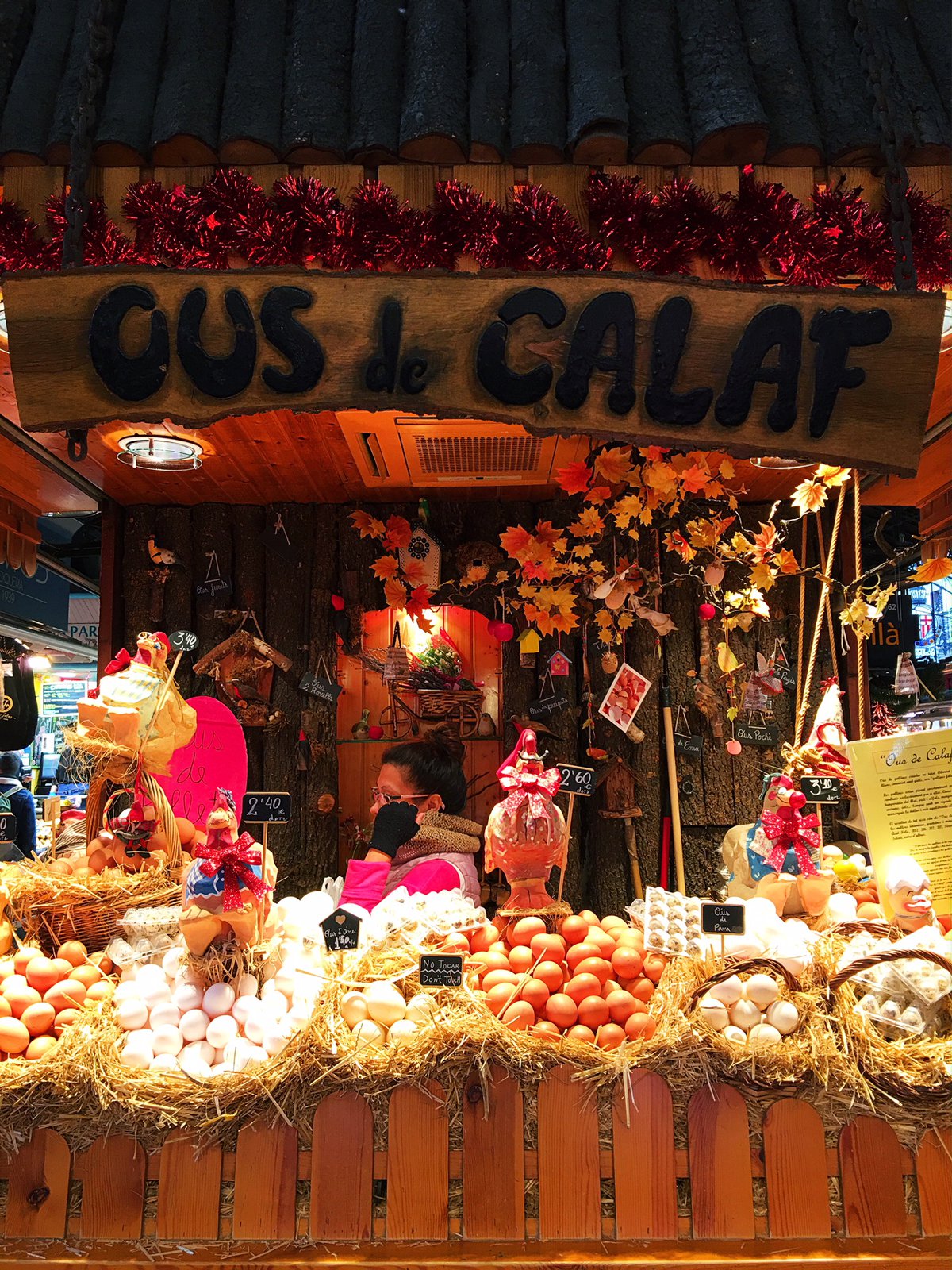
In 1835 the decision was made to construct a market on La Rambla, mainly for butchers and fishmongers. Now on average 200 vendors open their stalls every day, selling fish and meat, nuts and vegetables, fruit and eggs. There are vendors selling snacks and there are bars where you can sit down and have a drink and a meal.

La Bocqueria Barcelona

Related Post: 10 Things You Absolutely Must Do In Barcelona

La Bocqueria Barcelona

La Boqueria is a visual banquet, your eyes just don’t know where to land next! As you wander up and down aisle after aisle of market stalls you get caught up in the explosion of colors that make up the local Catalan foods. The sights and smells and sounds are wonderful!

La Bocqueria Barcelona

Although there is a tourist presence at the market, this is also a place where locals come buy their meats, fish and produce. Half the fun of being there is watching the locals interact with each other and with the vendors.

La Bocqueria Barcelona

You also get a keen understanding of Mediterranean cuisine, and how it is driven by the array of fresh, seasonal ingredients.

La Bocqueria Barcelona

When I travel in Europe I like to stay in vacation rental apartments instead of hotels. I love being able to shop in local markets and eat some meals at home, others at cafes and restaurants. Even if you’re just buying ingredients for a salad or something super simple to cook at the apartment it is so much fun shopping at La Boqueria! You can buy everything you need for a simple picnic or a giant dinner party, or anything in between.

La Bocqueria Barcelona

If you are only in town for a day, or are staying in a hotel, or don’t want to cook while you are in Barcelona you should still go check the market out. You can buy snacks or a takeaway lunch, or just visit it for a look around.

La Bocqueria Barcelona

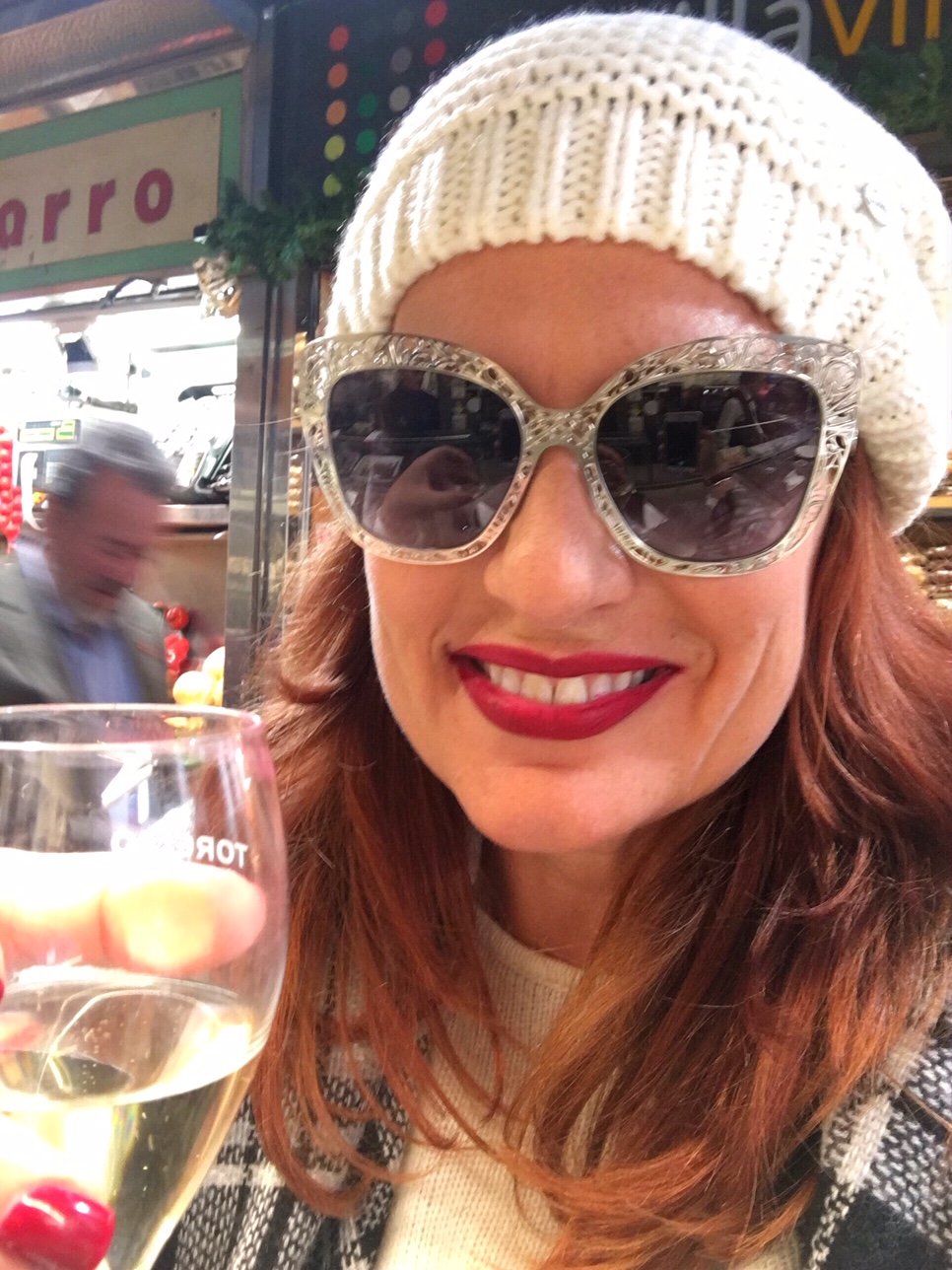
Before I leave La Boqueria I like to have a glass of cava (the Catalan version of champagne) and a snack at Pinotxos, the bar at the entrance to the market.

Corinna B's World La Bocqueria Barcelona

Pinotxos is family owned and family run, and has been around since long before my first trip to Barcelona a lifetime ago. It’s kind of fun to go back there after years and still see the same faces behind the bar!

Pinotxos La Bocqueria Barcelona

Barcelona, like many popular European cities, has a problem with pickpockets. They are incredibly quick and incredibly wiley, so any time you are in a crowded place such as a market or any major tourist spot you need to be super vigilant and very aware of your belongings. Keep you hand on your handbag at all times. You ideally should wear a cross body bag and keep it close to your person at all times.

Travelon makes an anti theft cross body bag that is perfect for travel. A cable running through the shoulder strap makes it slash proof, the body of the bag itself is slash-proof, it has RFID blocking slots for your credit cards and passport, keeping the digital information on your credit card magnetic strips and the digitized information on your passport unhackable. The zippers on the bag have caribiners that prevent pick pockets from slipping the zipper open and getting inside your bag. You can also loop the shoulder strap through your seat so no one can grab it and run while you are eating. You can find this bag online at The Container Store in a variety of styles.

See the video below for more details.


728 x 90 Orbitz Lost Stolen Passport


This post contains affiliate links. See Disclosure Page for details on how this blog uses affiliates.

Hi Ho Hi Ho It’s Off To Spain We Go!

Glam World Travel Barcelona

It’s time to fly the friendly skies again!

Actually we were supposed to leave yesterday but flights were cancelled due to snow in London.

This time we are heading out on a pre-Christmas run through the winter markets, architecture and art museums of Barcelona! My house sitter/makeup assistant has had to lend me some cold weather gear, and she tells me she is planning on flexing her cookie baking, cocoa making, HBO watching muscles while I’m away. I hope there’s some left for me when I get home!

I’ve been trying to learn some basic Catalan and have been dieting to make room for some hearty paella (there will be photos!)

If you’re in the mood to get your Gaudi on please follow this trip on my Instagram @Corinnamakeup

See you soon!

Verified by ExactMetrics