Discover The Ancient Greek temples Of Paestum

One of the (many) things that keeps me coming back to Italy the never ending supply of historical surprises waiting around each and every corner.
Everyone knows about the Colosseum, the Leaning Tower of Pisa, the Grand Canal in Venice. I love all the big, well known postcard famous sights, and will always go back to them, but I find pure magic in the lesser known, less visited ‘secret’ places that I stumble upon every time I’m there.
Paestum-Italy

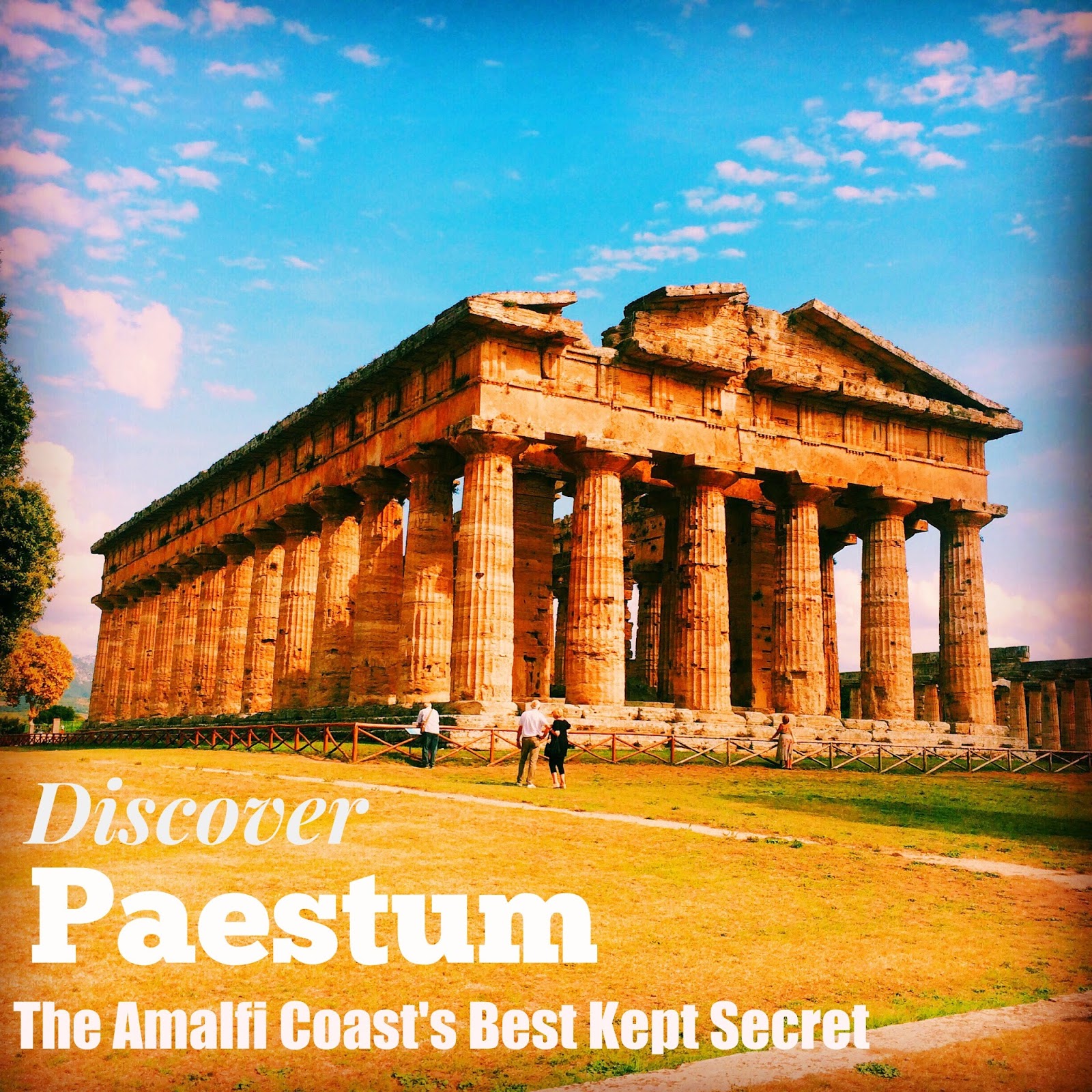
This year I took my Corinna B’s World Glam Italia Tour to several of my secret Italian places, one of which was the magnificent Paestum, located an hour south of Salerno, south of the Amalfi Coast.

Paestum is the Roman name for a small, ancient Greek city in Campania, formerly known as Poseidonia (back when southern Italy was known as Magna Grecia in the 8th thru 5th centuries BC).
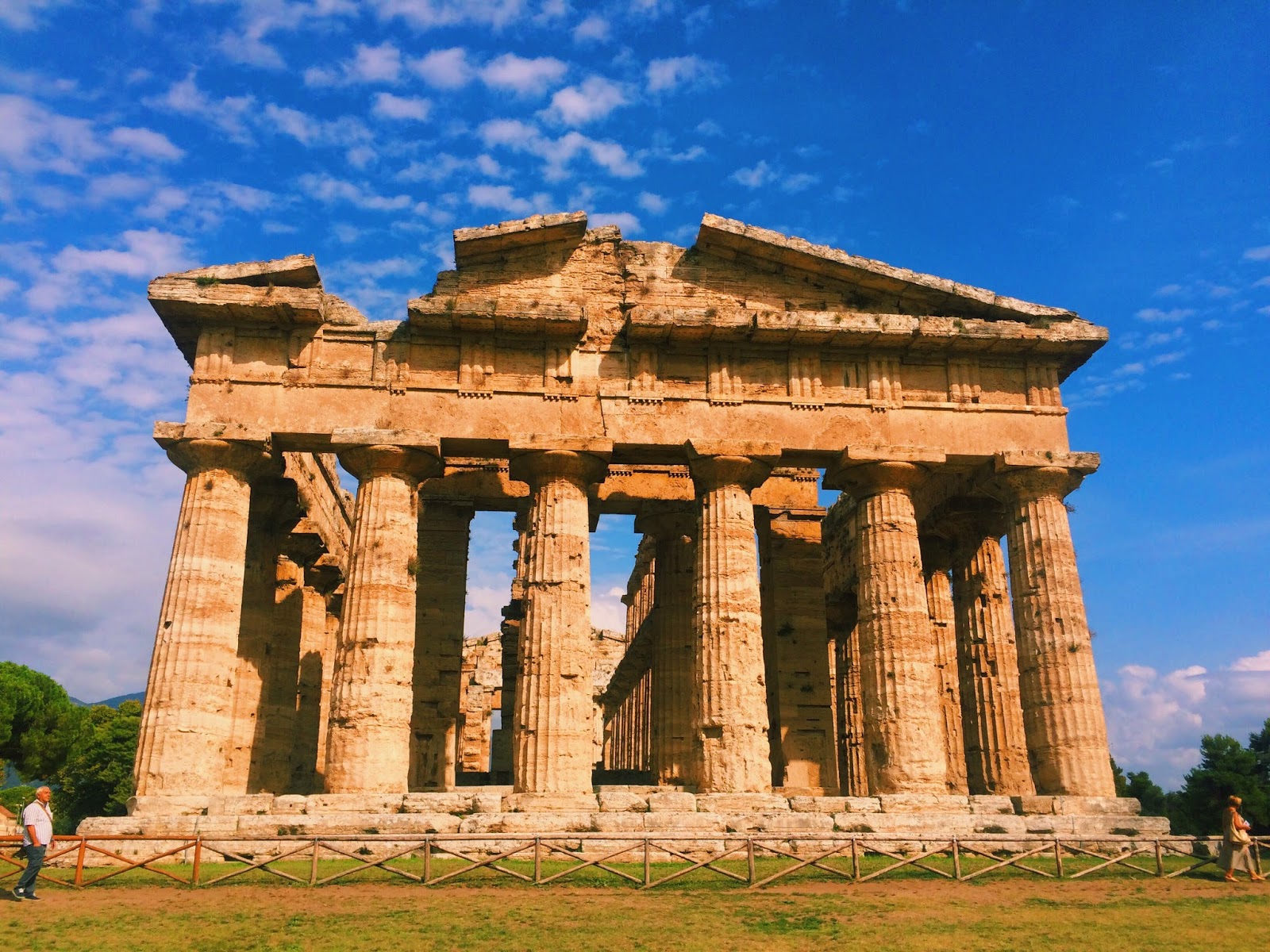
Greek-Temple-Paestum
Temple Hera II, Paestum

Paestum is the home of 3 of the best preserved Greek temples in the world. (The other 8 best preserved Greek temples are not found in Greece, but in Sicily’s Valley of the Temples, near Agrigento.)

The experience of visiting Paestum is just staggering.
In the middle of nowhere, as you drive through the countryside past farms that make bufalo mozzarella, suddenly these three giant temples rise up majestically out of the landscape, completely taking your breath away.
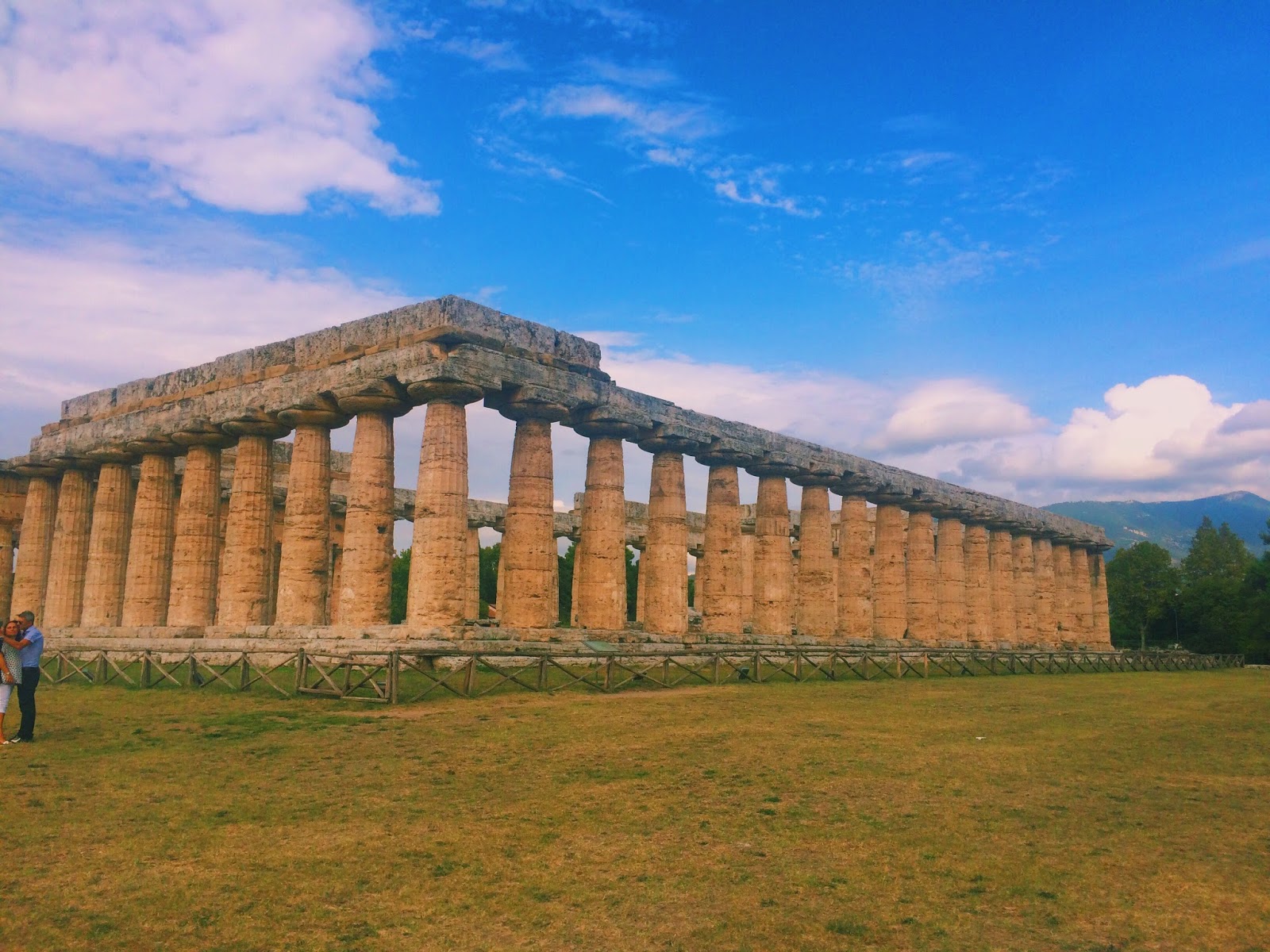
Paestum-Temple
Hera I, Paestum

They are huge. They are magnificent. They are ancient. And they are unspoiled.

Related Post: Things You Probably Didn’t Know About Pompeii

Built 2500 – 2600 years ago, before even the Parthenon, this is really ancient Greek. The scale of these temples, the force with which they rise up out of the earth and the absolute beauty of them just leaves you at a loss for words.
Goethe said it was like a strike of lightening hitting his mind.
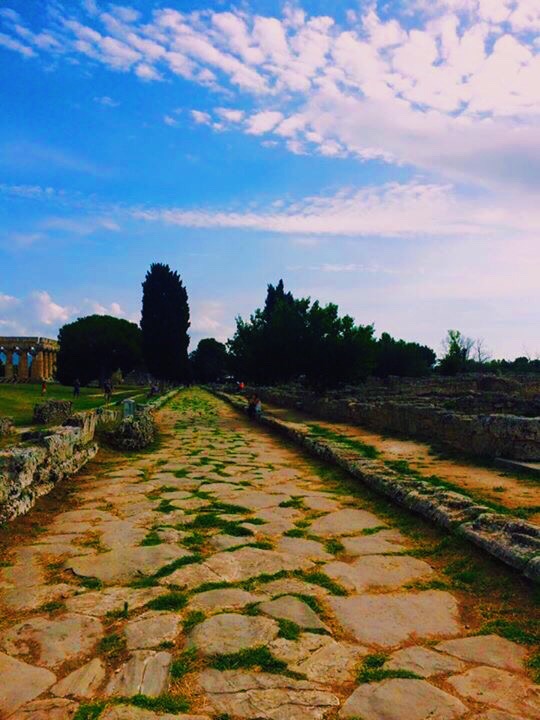
Roman-town-Paestum
Roman road built circa 300 BC, with roman apartment buildings on the right, and temples on the left

You really feel like you are standing in a vanished, ancient city.
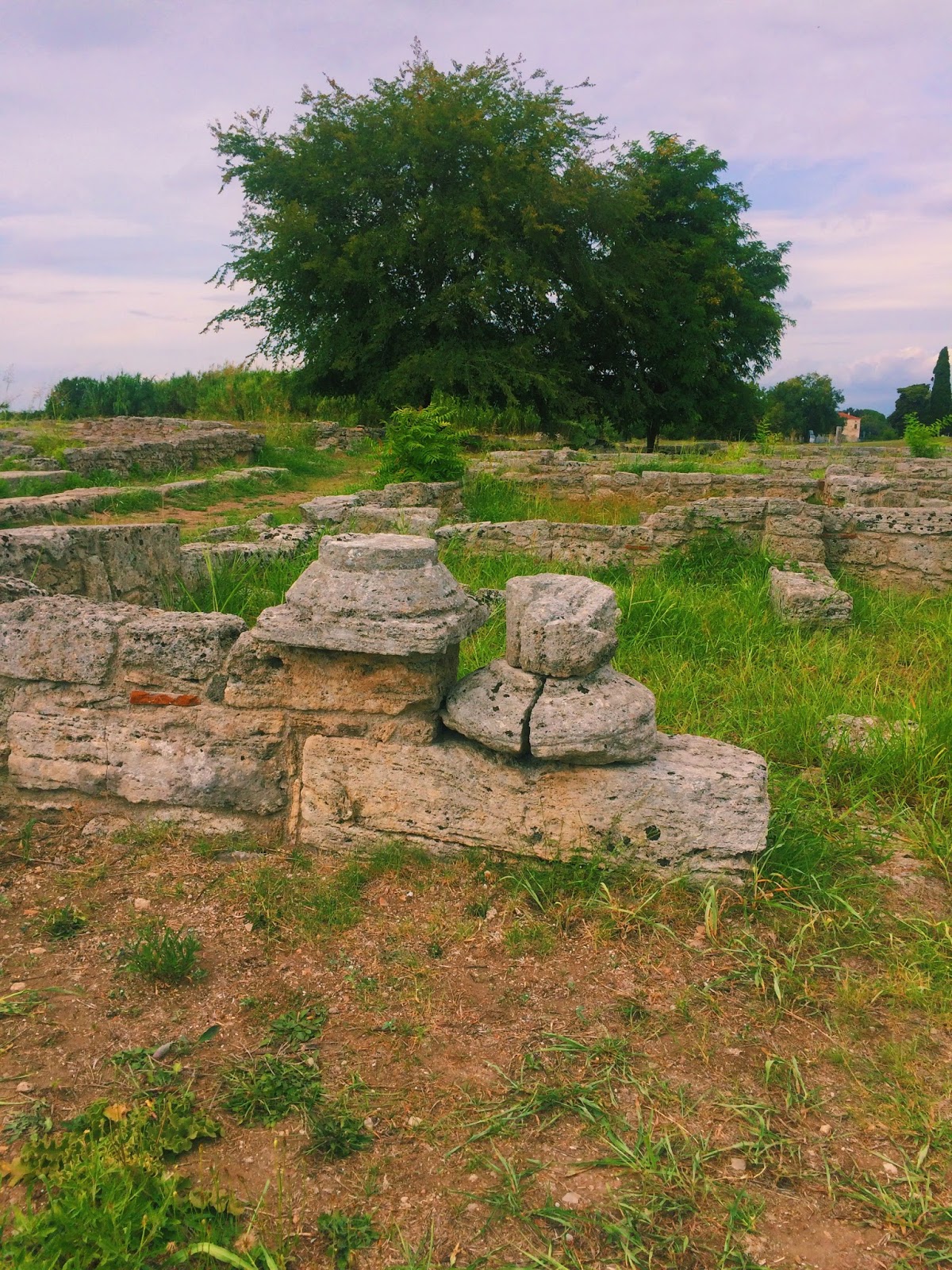
Paestum-Italy
remains of Roman  apartment buildings in Paestum

Paestum is a little remote, and unlike Pompeii which is surrounded by shops and vendors and tourism as well as neighborhoods where locals live, here there is almost nothing. And no one. Just you, the breeze coming off the ocean and a mere handful of other tourists.

Related Post: 8 Things You Must Do In Naples

The Greeks were always in search of perfection and ideal beauty, and they liked to build their temples and ampitheaters with beauty in mind and with gorgeous views, especially over water.

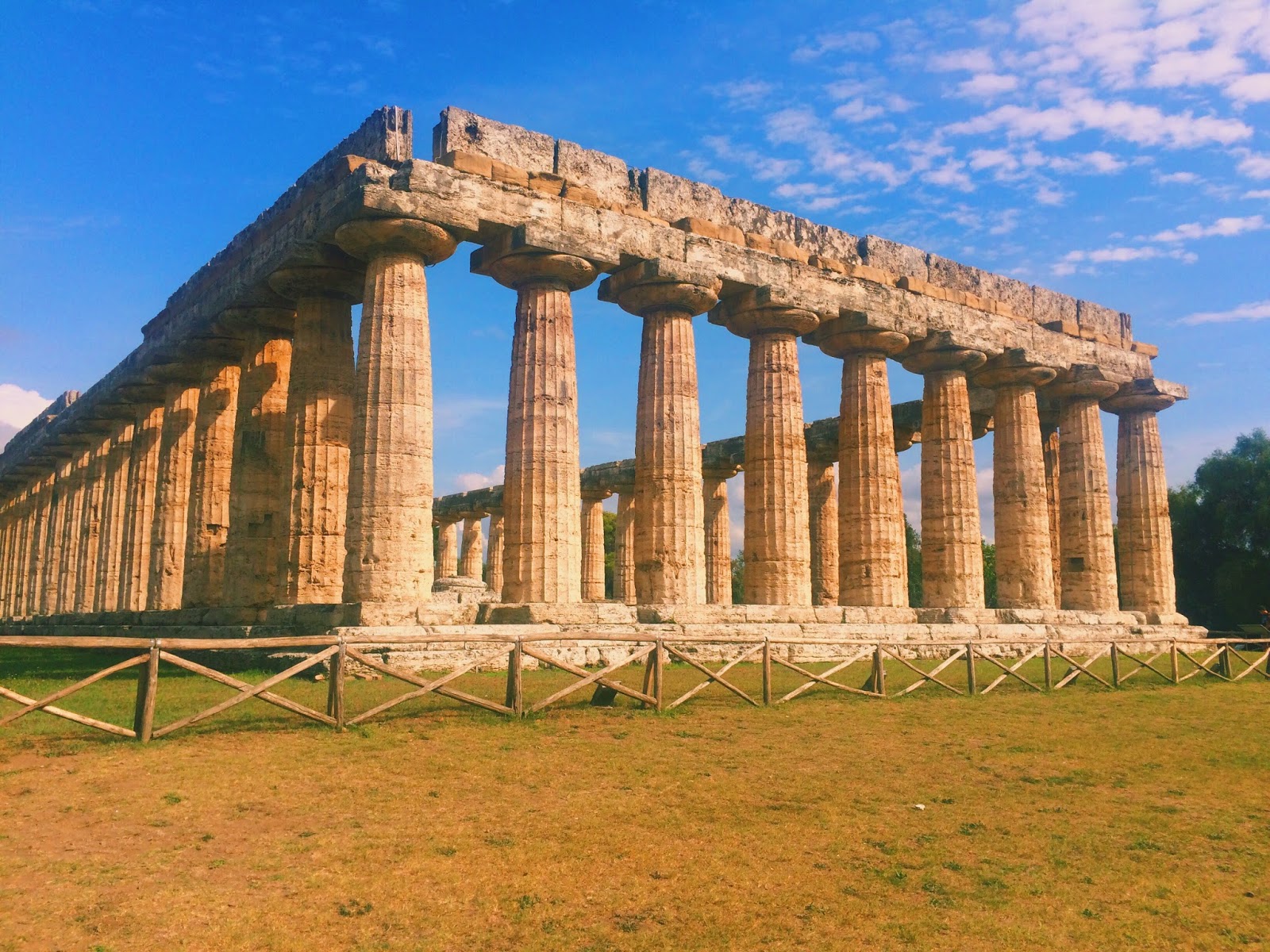
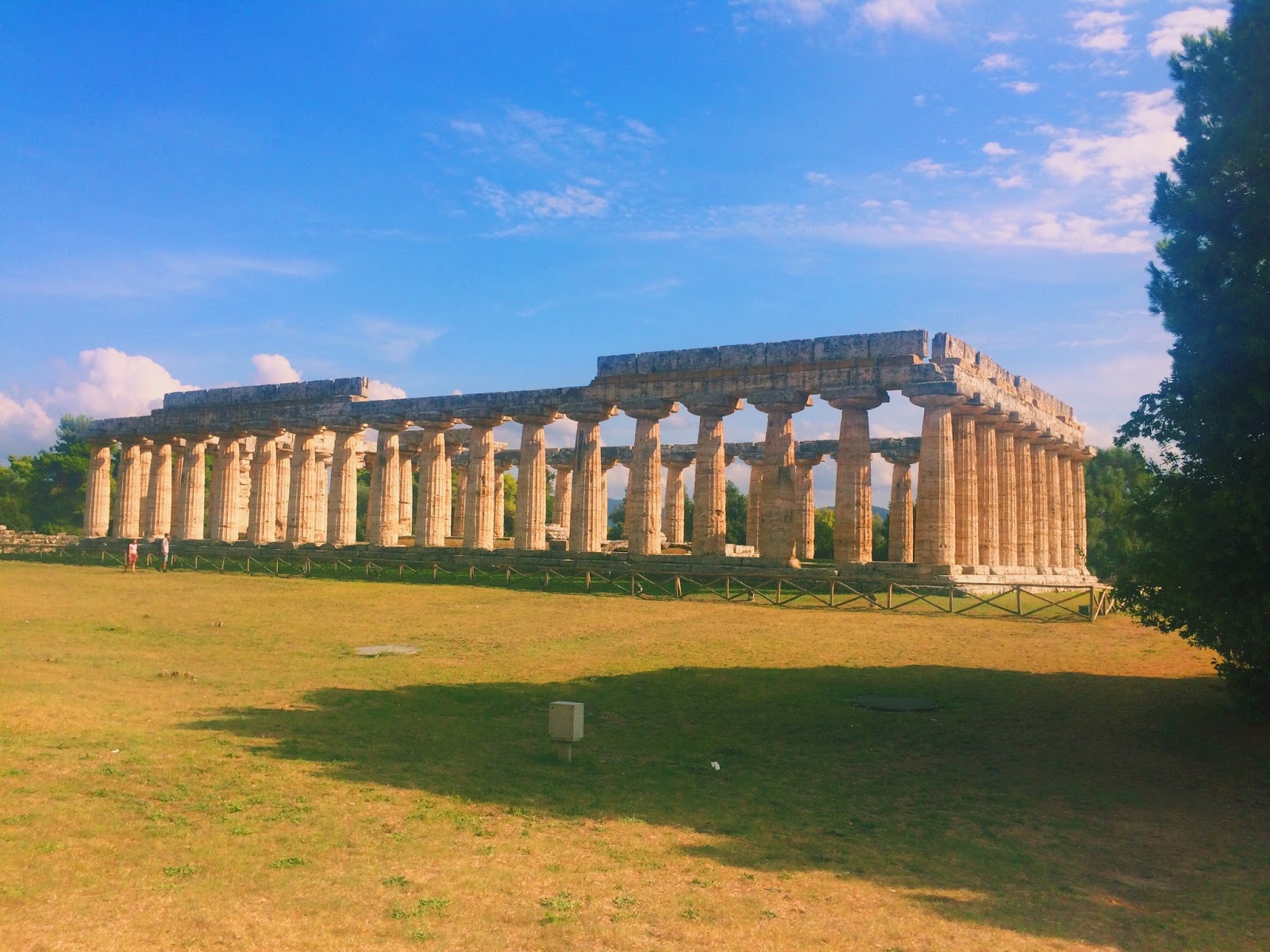
Grouped closely together, the first temple is Hera I, built for the goddess of fertility and wife of Zeus, circa 550 BC.
Hera I is also known as The Basilica. has perfect geometric doubling with 9 columns at each end and 18 along each side, giving it a very horizontal feel. It has massive heavy columns that have no feet, instead rising up from the stylobate and ending in a simple geometric capital. To support the weight of the roof the columns bulge in the middle and taper at the top.
Hera-I-Paestum
Hera I, The Basilica, Paestum

It was built from local stone and then stucco’d, but the stucco is long since gone. This temple is massive, yet in spite of it’s size retains a gracious femininity and equanimity.

Related Post: 10 Things To Do On The Amalfi Coast
The-Basilica-Paestum
Hera I, Paestum

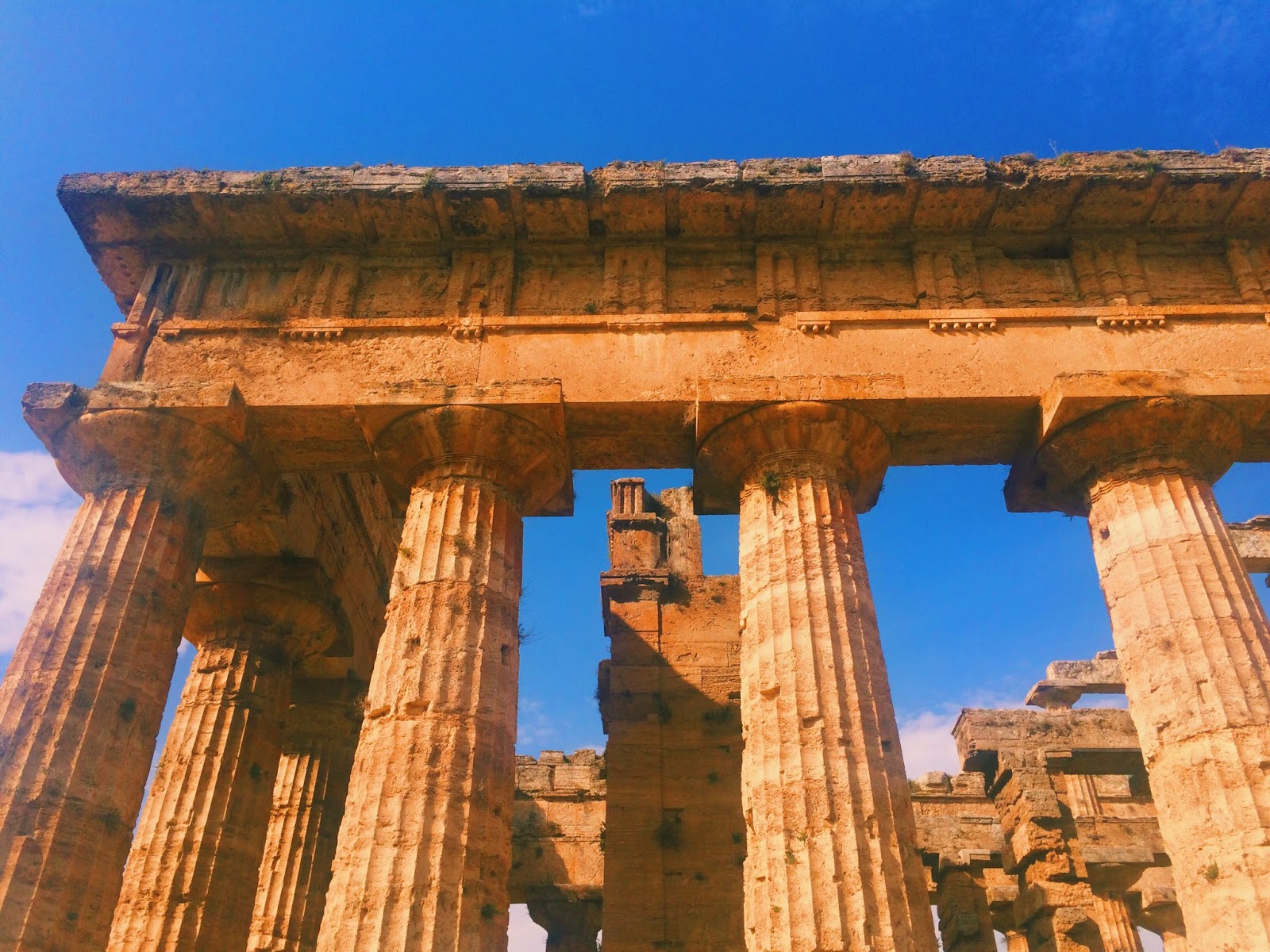
The middle temple is known as Hera II, and was built circa 460 BC.
With 6 columns along each end and 14 columns along each side, Hera II feels like an exercise in perfect balance. Standing beside Hera I she by comparison feels very vertical and slender. The 6 column figuration in front means you can walk through the middle, making her feel more symmetrical.

Paestum-Hera-II-Temple
Hera II, Paestum

It is thought that Hera II would have had a terracotta roof, and she appears to have had a second story, or perhaps some form of platform that sat over top of the ground floor.
Both Hera I and Hera II face the ocean. You can imagine how magnificent they must have looked standing side by side, gleaming white in the hot Campania sunshine as they watched over the blue sea from the front and the fertile pastureland from the back.
Inside-Hera-II-Paestum
inside Hera II

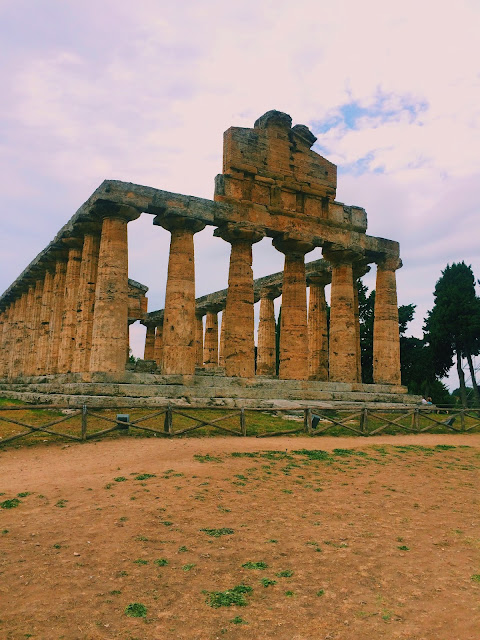
The Temple of Athena, also known as the temple of Ceres, built in 500 BC. This is actually the first temple you see as you drive into town. It sits a little higher and away from the other two temples, which stand side by side.
 

Ceres-Paestum

Ceres/Athena Temple in Paestum

Interestingly this temple has Doric columns on the outside and Ionic columns on the inside.
In front of the temple is an alter where sacrifices took place.
Greek temples were houses to the Gods, where statues were stored. Ceremonies and worship took place at the alter outside of the temple.

In Paestum Hera was not only the Goddess of fertility, but also of childbirth.
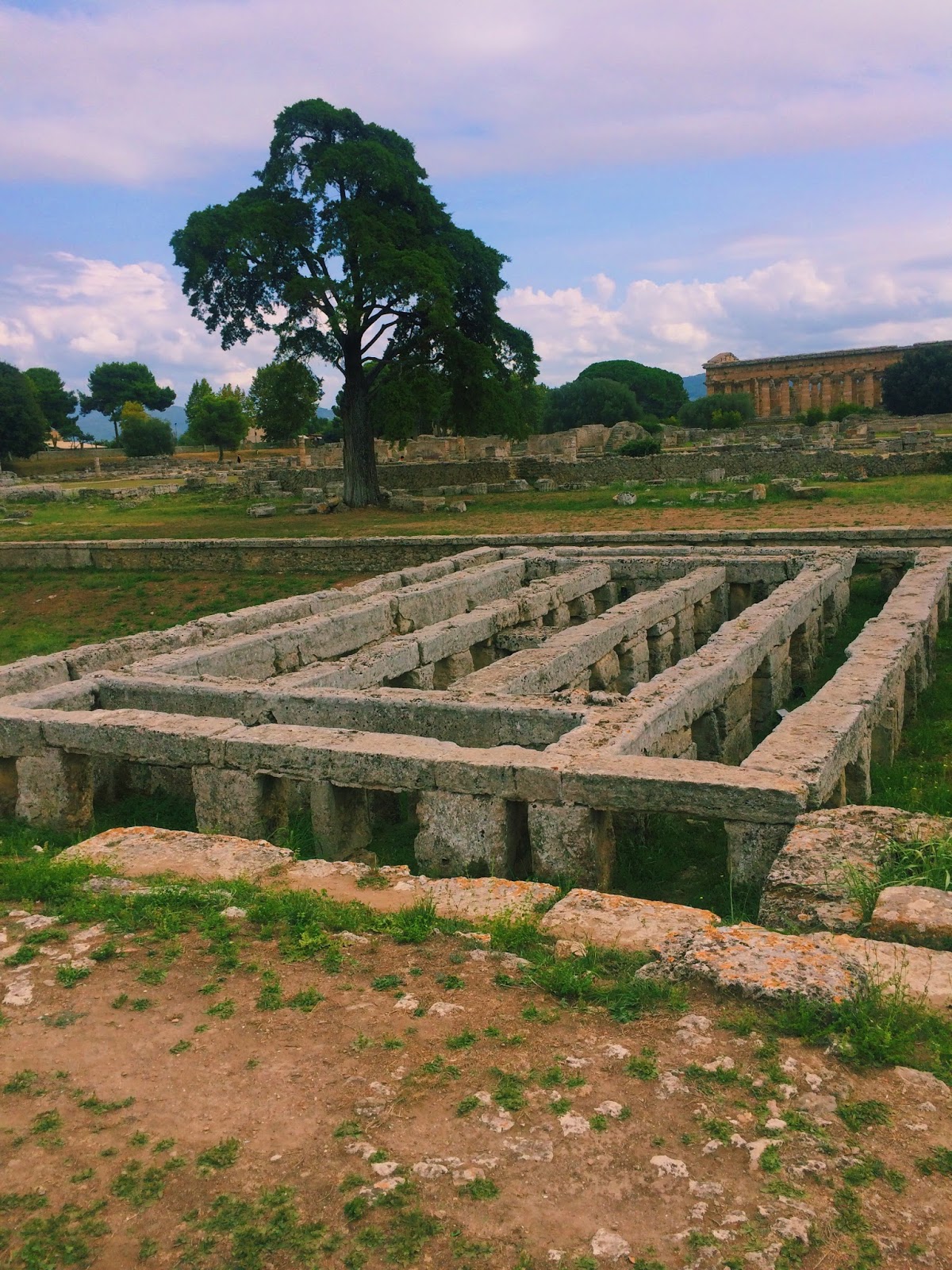
Fertility-Hera-Pool
Hera’s fertility pool, Paestum

An elaborate pool was built for Hera where women who were trying to conceive could bathe and sit, but also where women would come to ask Hera for an easy childbirth.

Related Post: The Palace Of Caserta

When the Romans took over the area in the 3rd century BC they didn’t destroy the temples, and they didn’t just move down the road a ways to build their new city out of sight of them, instead they renamed Poseidonia to Paestum and built a city around it’s temples.
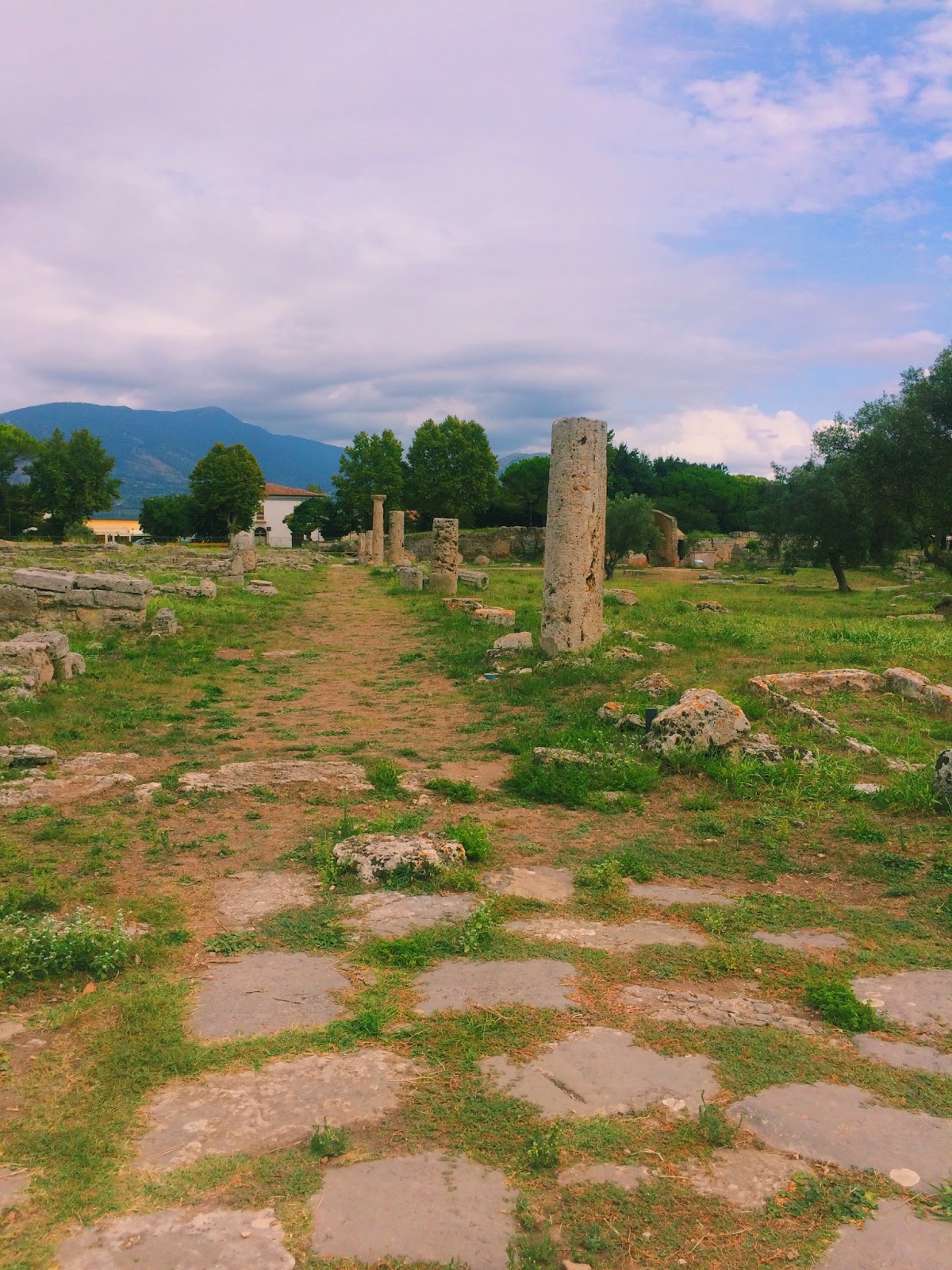
Roman-Town-Paestum
ancient Roman roads in the city of Paestum, beside the temples

This adds another layer of magic, as you can walk through the wide streets of this roman town and into apartment complexes that border the temples.

Roman-apartment-Paestum
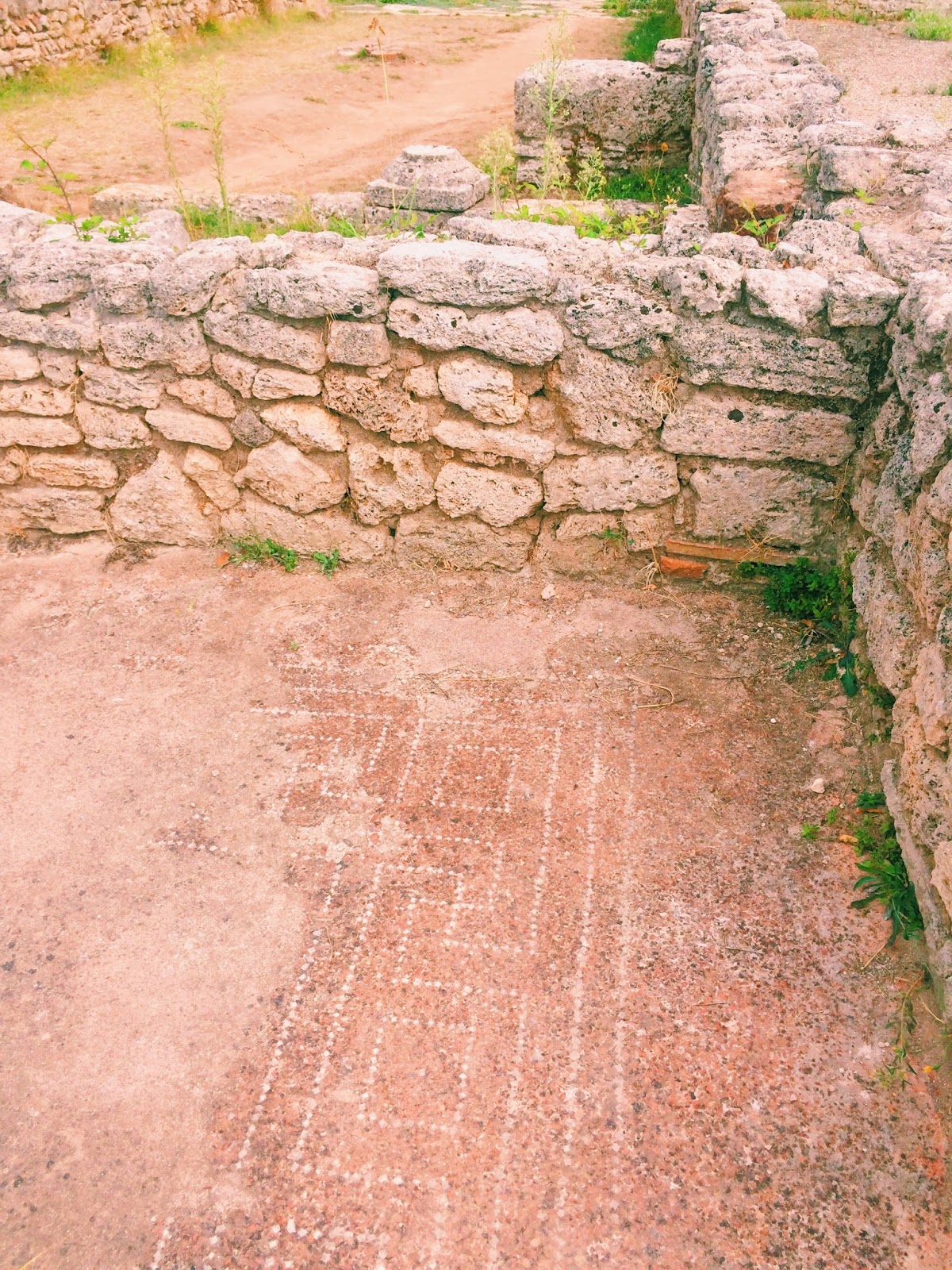
mosaic floors more than 2300 years old, in Roman apartments in Paestum

Who knew that the Romans built apartment buildings? I didn’t.
There are still mosaic floors intact, and enough of the structure of the ruins remain so that you can figure out where the front door was, what the view was, where the various rooms were positioned.

Paestum-Mosaic-Floor
mosaic floors at the entryway to a Roman apartment, circa 300 BC
Paestum-Apartment
inside another Roman apartment

There is a small museum opposite the temples, where you can see the oldest surviving wall paintings from ancient Greece, which makes them also the oldest surviving wall paintings in all of western art.
In 1968 the excavation of a tomb in Paestum unearthed paintings dated to around 480 BC.


Paestum-Painting-Tomb
art was a celebration of the love amongst men

This ancient Greek world was a homo-erotic world. If you were going to be in love it would be with another man. Men were for love, women were for procreation.


Greek-erotic-art-Paestum
the ceiling of the tomb

Paestum is one of the most spectacular places I have ever been.

And it’s one of those treasures that no one seems to know about. We were there on a free Sunday, and I had been worried that it would be overflowing with tourists taking advantage of the zero ticket price, but in all the hours that we were there exploring there would not have even been 100 people total. Probably not even 50. It felt as though we had this giant, spectacular slice of history all to ourselves.

If you do take the time to visit Paestum I definitely recommend visiting Pompeii first, as it will give you a fantastic understanding of how Roman homes were laid out, and this will add another dimension to the already incredible Paestum experience.
If you are staying on the Amalfi Coast it is well worth giving up a half day or a day and taking the train to Paestum. It’s a long drive from Positano or Sorrento, but by car from Salerno it only takes one hour.
I am amazed that there is such a mad tourist crush in nearby Capri, sometimes you can barely walk down the street in Positano there are so many people, and yet there is virtually no one visiting Paestum.

Related Post: How To Order Coffee In Italy

Paestum is not actually on the Amalfi Coast, but for most people traveling in the region, the Amalfi Coast is the closest geographical reference that they will be familiar with. 

All photos taken with my iPhone remain my property. Please do not re-use without my written permission.

Allianz Travel Insurance

Just One Day In Procida

Corricella-Procida

I have been to Capri many times, and loved it.
But lately Capri has felt less like the jet-set world of Jackie O, and more like the hellish realm of a disgorged cruise ship.

Capri is definitely chic. No question. But it has become horribly touristy. There is invariably a cruise ship or two in the harbor, and during the day the piazzetta can be a nightmare crush of humanity that you have to wade your way through in order to get anywhere. Somewhere along the way I started losing interest.

When I was planning this year’s Glam Italia Tour, which included a week on the Amalfi Coast I just couldn’t face taking anyone to Capri. I know I will go back at some point, but for now I have a new island love, and that love is called Procida.

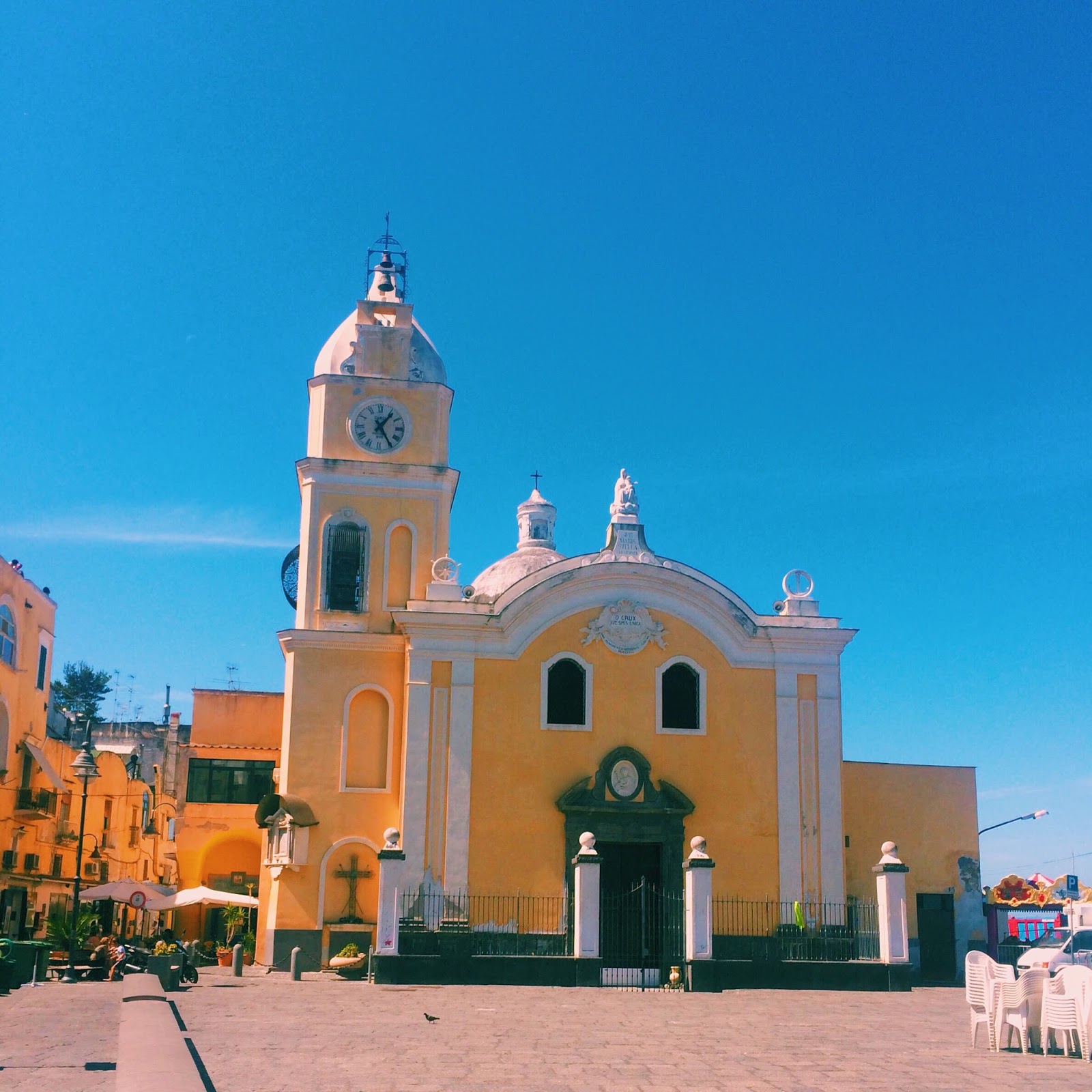
Procida-Church
Arriving in Procida

Procida is the smallest island in the Bay of Naples’ Campanian Archipelago, at a mere 3.2 km long.


Procida-marina
incredibly colorful arrival in Procida!

One of the 24 most colorful places in the world, Procida has attracted movie directors over and over as the setting for their films, so much of it may feel familiar to you.
(The movie Il Postino was shot on Procida and on the Aeolian island of Salina).


Corricella-Procida
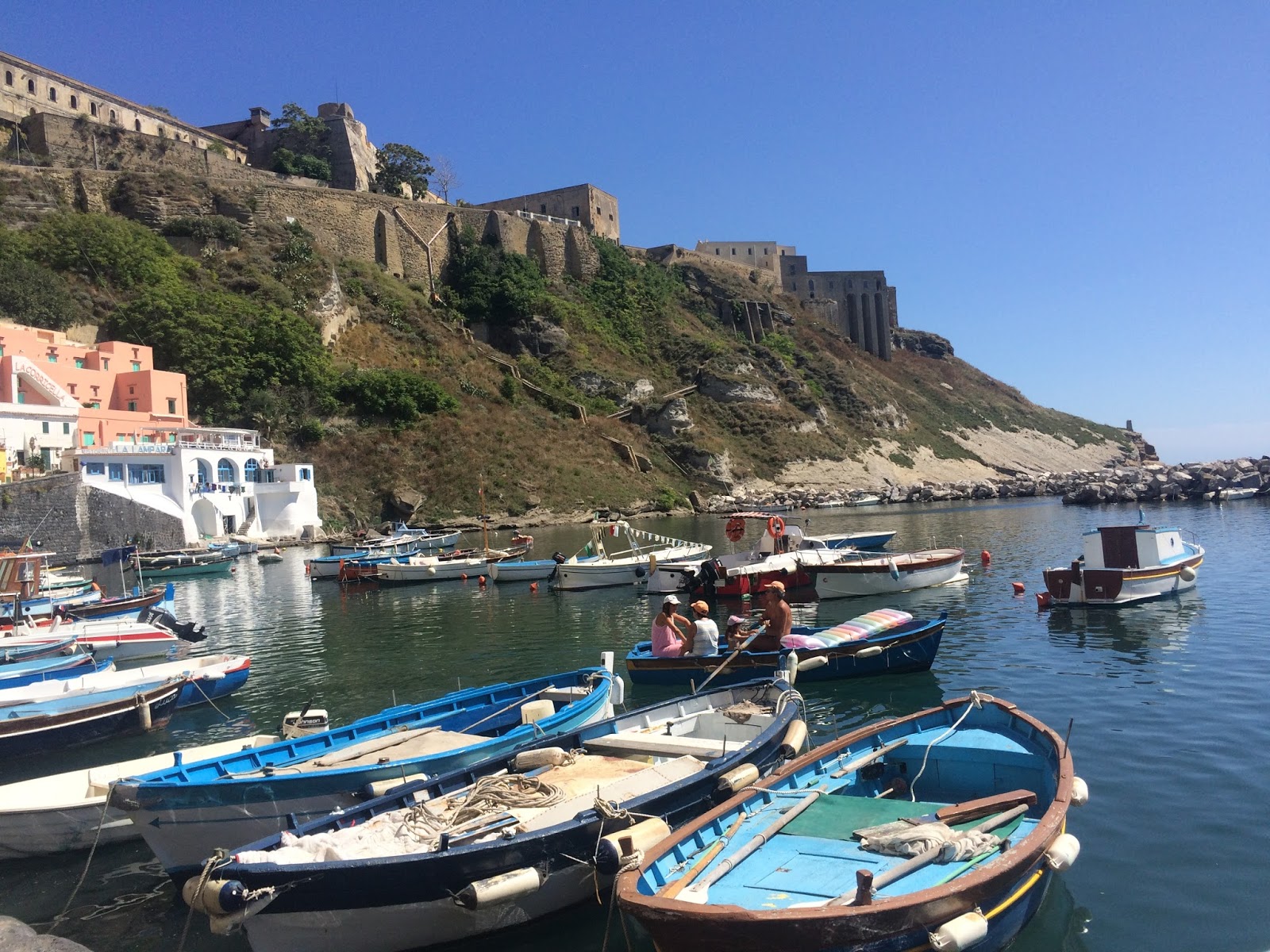
Marina Corricella, Procida

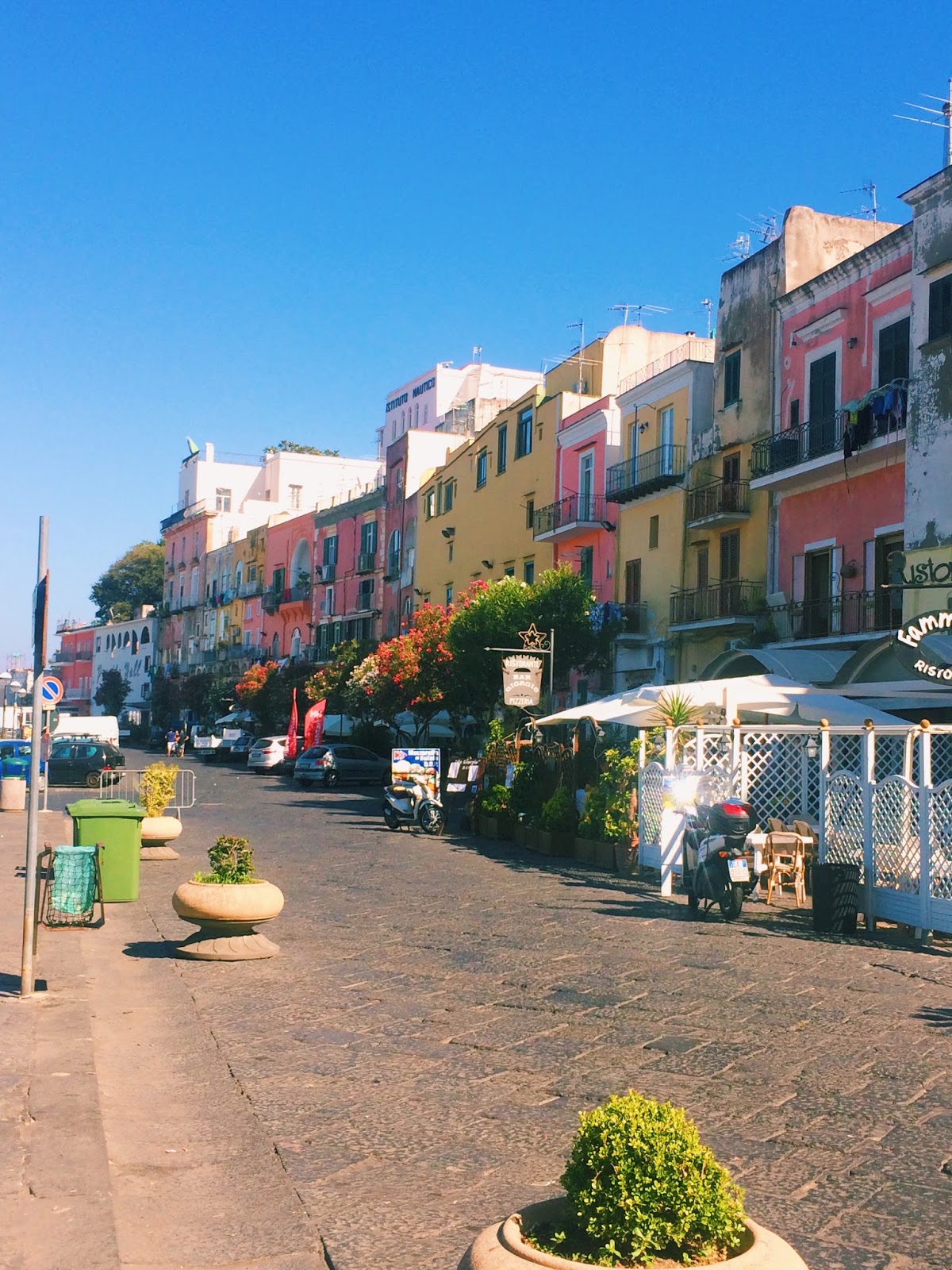
You get to Procida by ferry or hydrofoil from Naples, and the “wow” factor on arrival is just staggering. Out of the blue, blue ocean, set against the blue, blue sky erupts an explosion of color in the form of bright yellow and pink fishermen’s houses, that will take your breath away.

 Related Post: 8 Things You MUST Do In Naples

Port-Of-Procida
morning sun in Procida

Procida feels authentic. A weekend retreat for the people of Naples, it doesn’t have the manic tourism and outdoor mall feel of nearby Capri.

Where to stay on Procida

I did spot one Tshirt shop while there, and I’m sure there must have been a couple more, but as you walk around town you feel as though you have stepped into some secret slice of shabby-chic Italian island life that hasn’t been polluted by major retailers and Chinese manufacturers.
It looks and feels real.


Procida-Italy
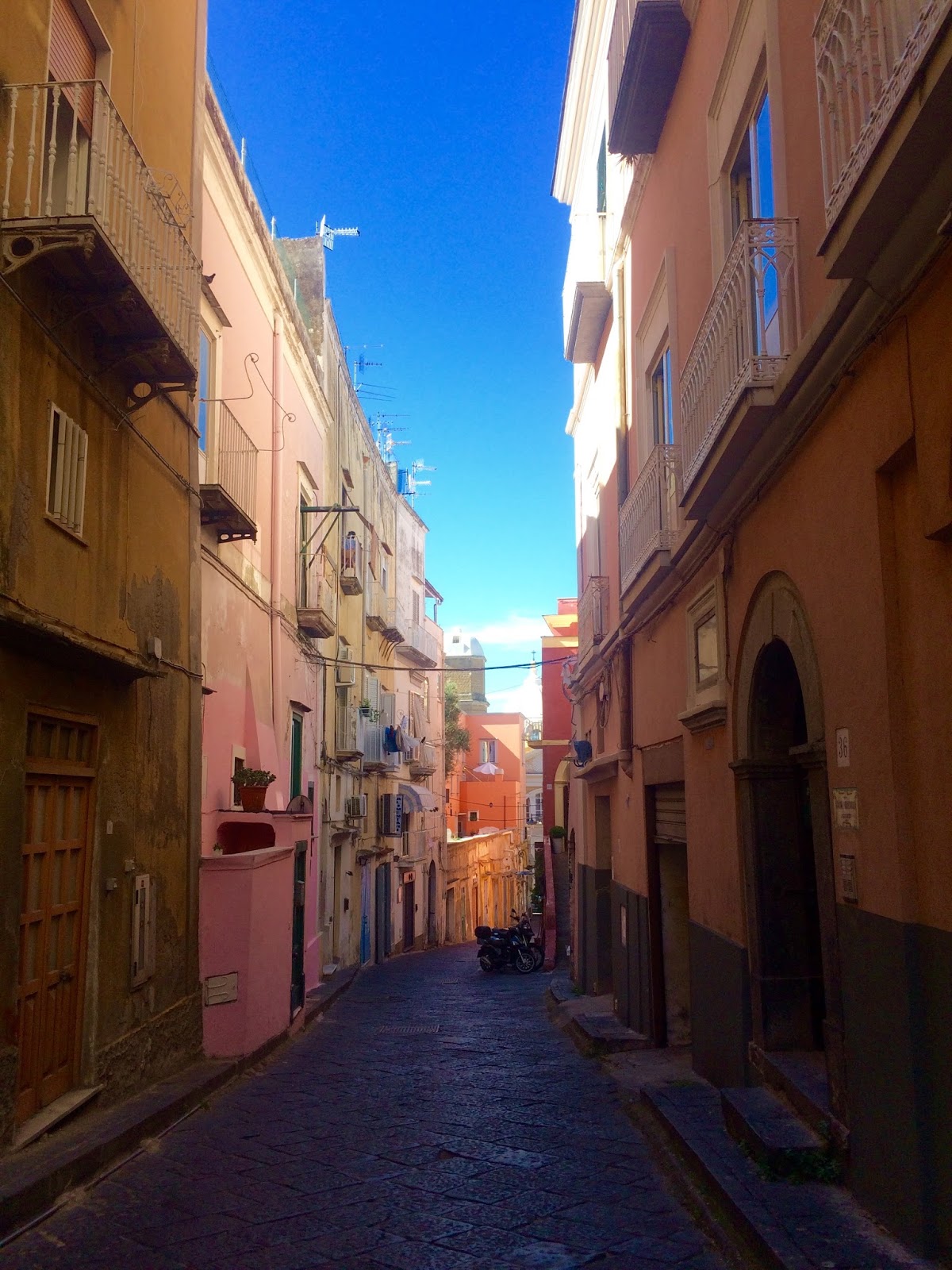
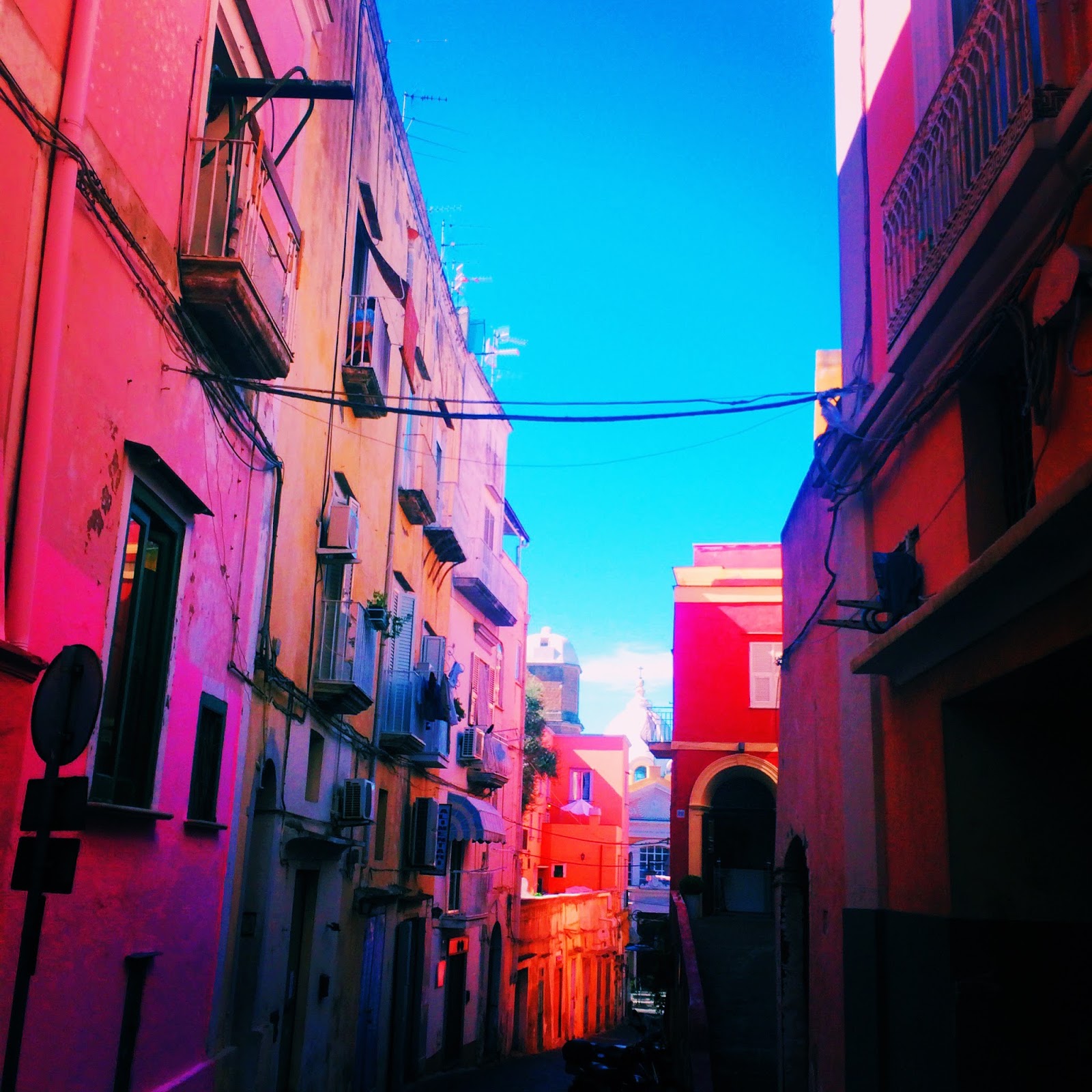
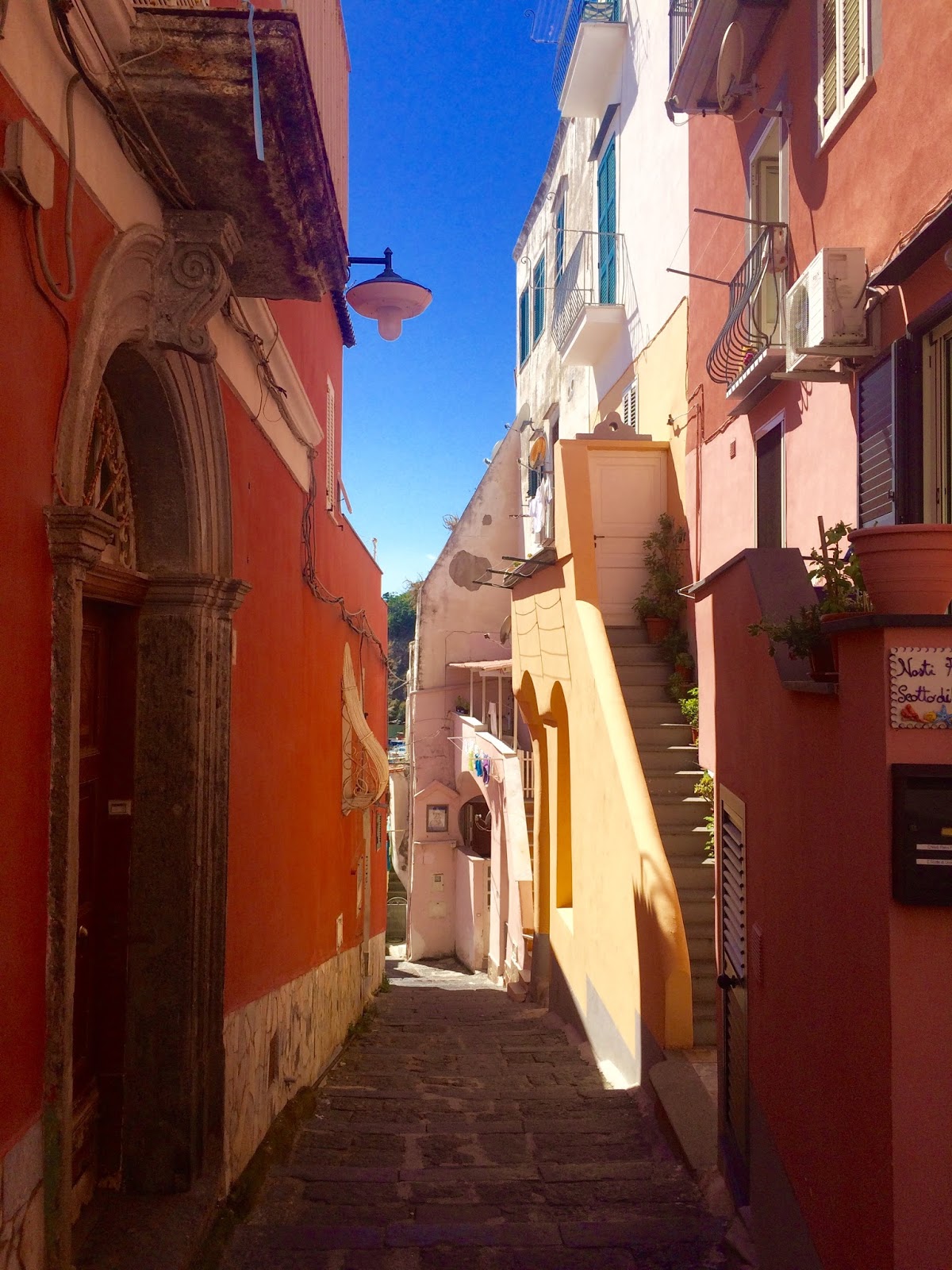
narrow streets of Procida

The streets are narrow and windy and in some places steep. You can spend hours just wandering around and exploring.


Procida-Pink
pink houses in Procida

The perfect day trip to Procida would start by taking the very first ferry or hydrofoil from Naples.
Walk around the port area and have an espresso or two, then take your time and discover the streets as they weave and wind up the hill, working your way over to Corricella.

 Related Post: 10 Things You Must Do On The Amalfi Coast

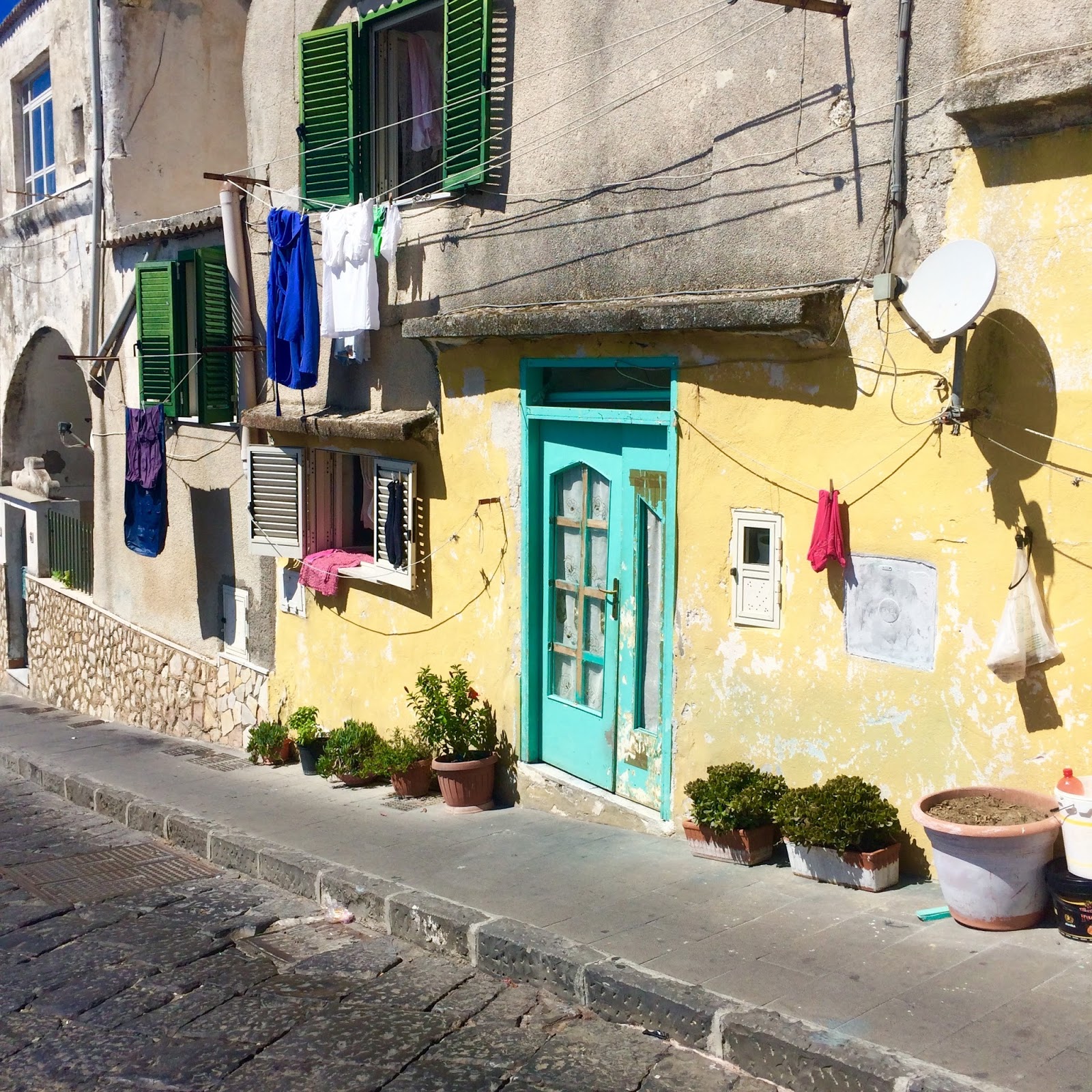
Washing-Procida
socks hanging out to dry on shutters

Marina Corricella, is a darling and picturesque sliver of a bay that backs onto a cliff made out of fisherman’s houses.


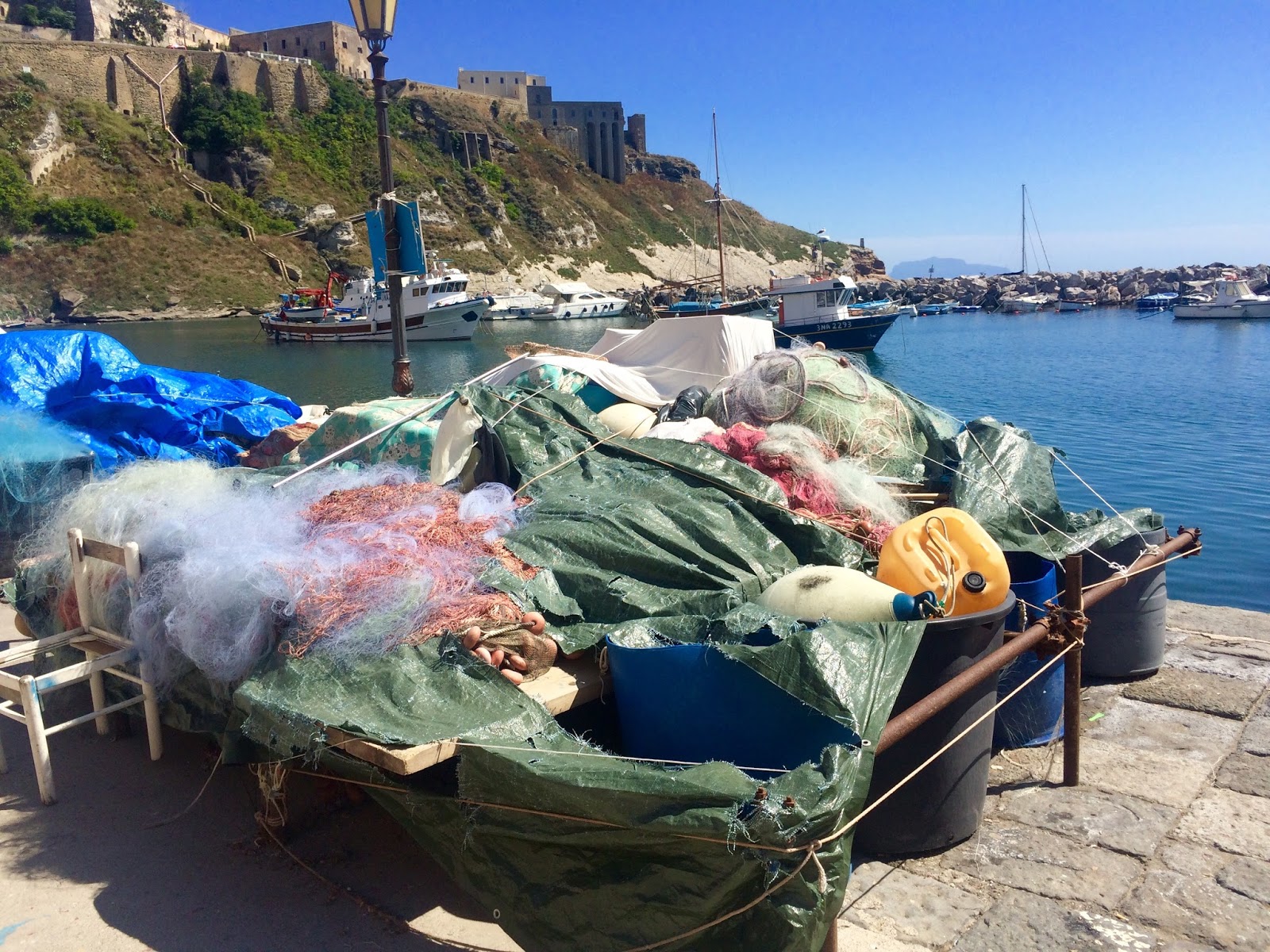
Procida-Corricella-Fishing-Nets
fishing nets drying in the sun, Corricella, Procida

Fishing nets lie out to dry along the waterfront and fishing boats moor against the sea wall – did I mention it feels authentic??


Fishing-Boat-Marina-Corricella-Procida
fishing boat moored in Marina Corricella

Marina Corricella is the perfect place to stop for lunch. There are several oceanfront restaurants to choose from, but we wound up taking in the view from Bar Graziella. The hilarious and engaging owner Vincenzo opened Bar Graziella in 1964, and apparently was the first restaurant in Corricella.
The food is bountiful and inexpensive. We ordered a platter of seafood antipasti and a salad, supposedly an order for one person, but there was more than enough for 4!


Corricella-procida-Bar-Graziella
Lunching under the umbrellas at Bar Graziella, Corricella, Procida

After lunch walk along the eastern shore from Corricella to Chaia beach. You’ll take a long flight of stairs to the sand but you need the walk to burn off lunch.

 Related Post: 18 Things You Probably Didn’t Know About Pompeii

Procida-Pink-Streets
streets of procida

When you are done beaching head either on foot or by bus up to Terra Murata and Abbazia di San Michele. You can check out the walled fortress which was at one time a monastery and until recently a prison, take in the stunning panoramic views of the Bay of Naples. Here from the highest point on the island you can walk down through the two stone gateways into the still inhabited idyllic settlement of Terra Murata. Wander around some more, and make sure you visit the art filled, romantic little church, Abbey of St Michael.


selfie in Celine sunglasses in Procida

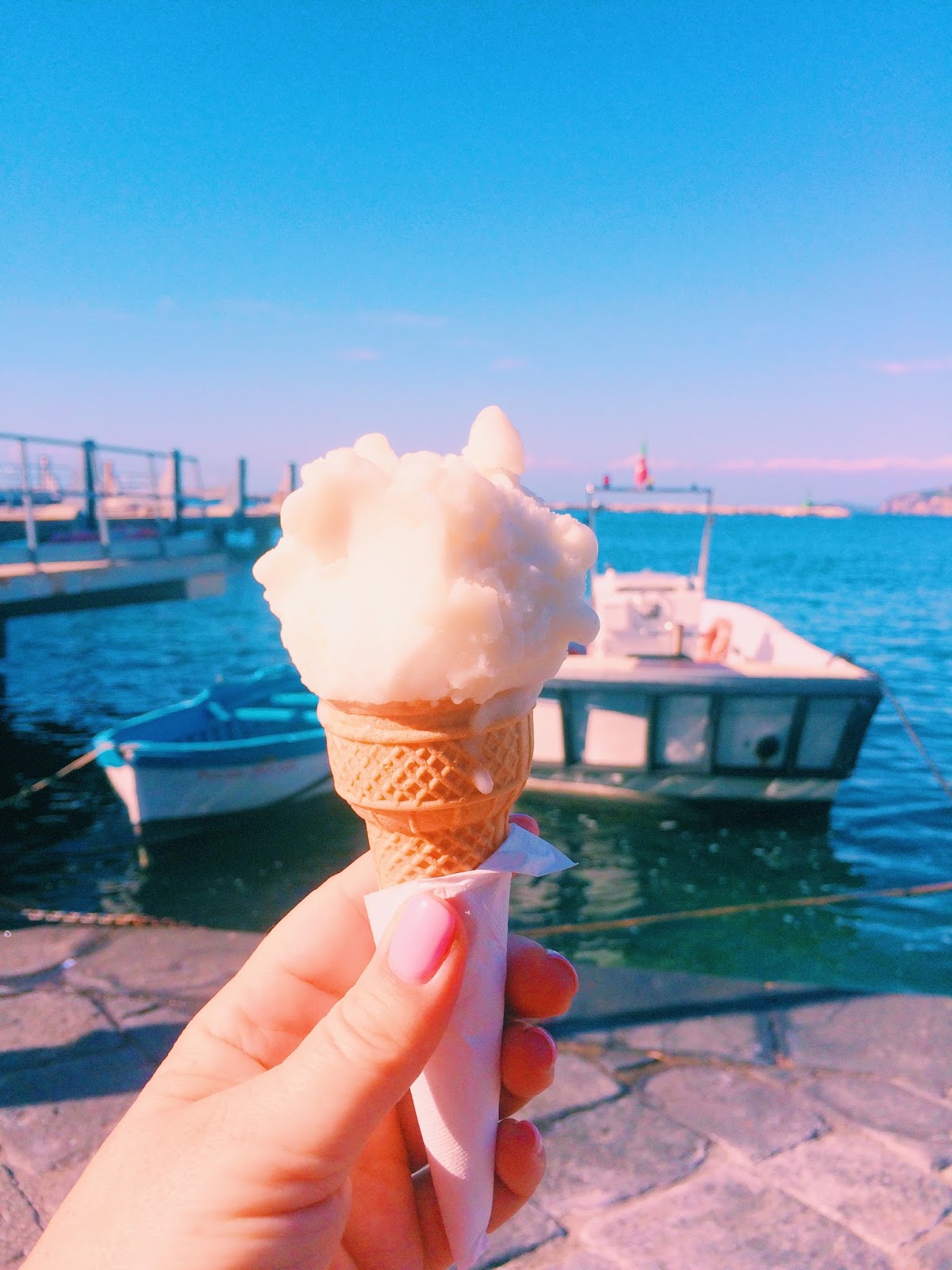
Sightseeing done, make your way back to the port and enjoy a locally made gelato before boarding your hydrofoil back to Napoli.

 Related Post: The Ancient Greek Temples Of Paestum

Procida-Port-Gelato
Limon Gelato, Procida

My only regret about the Glam Italia 2 Tour is that I allowed just one day in Procida.
Although the island is small, it is the perfect place to escape to. You can stay here for days on end doing nothing much at all. Evenings on Procida are said to be magic. This is the ideal spot to sneak away to with your Italian lover, or to plan a little romantic getaway.


Another place to stay on Procida (check out these photos!)

From nearby Ischia it is 30 minutes by boat, from Naples 40 minutes by hydrofoil.

All images in this post apart from the one noted, were taken with my iPhone during the Glam Italia 2 Tour. Please do not use any of them without written permission from me.


Allianz Travel Insurance

Things You Probably Didn’t Know About Pompeii

Streets-In-Pompeii

In 79 A.D Mount Vesuvius erupted. Ash and pumice rained down on Pompeii, an oceanfront merchant city at the bottom of the mountain, completely burying it. For the next 1700 years Pompeii disappeared off the face of the earth.

For 16 centuries stories were told about this mysterious town that had disappeared. Numerous expeditions set out to find it, but part of their problem was that they were searching the coastline, not realizing the eruption had moved the coastline 2 kilometres out to sea. The city was buried under 20 feet of volcanic ash, which had become verdant and fertile farmland. It wasn’t until the late 17th century when a farmer was digging a new well that Pompeii was onc again discovered.


Plaster-Cast-Bodies-Pompeii
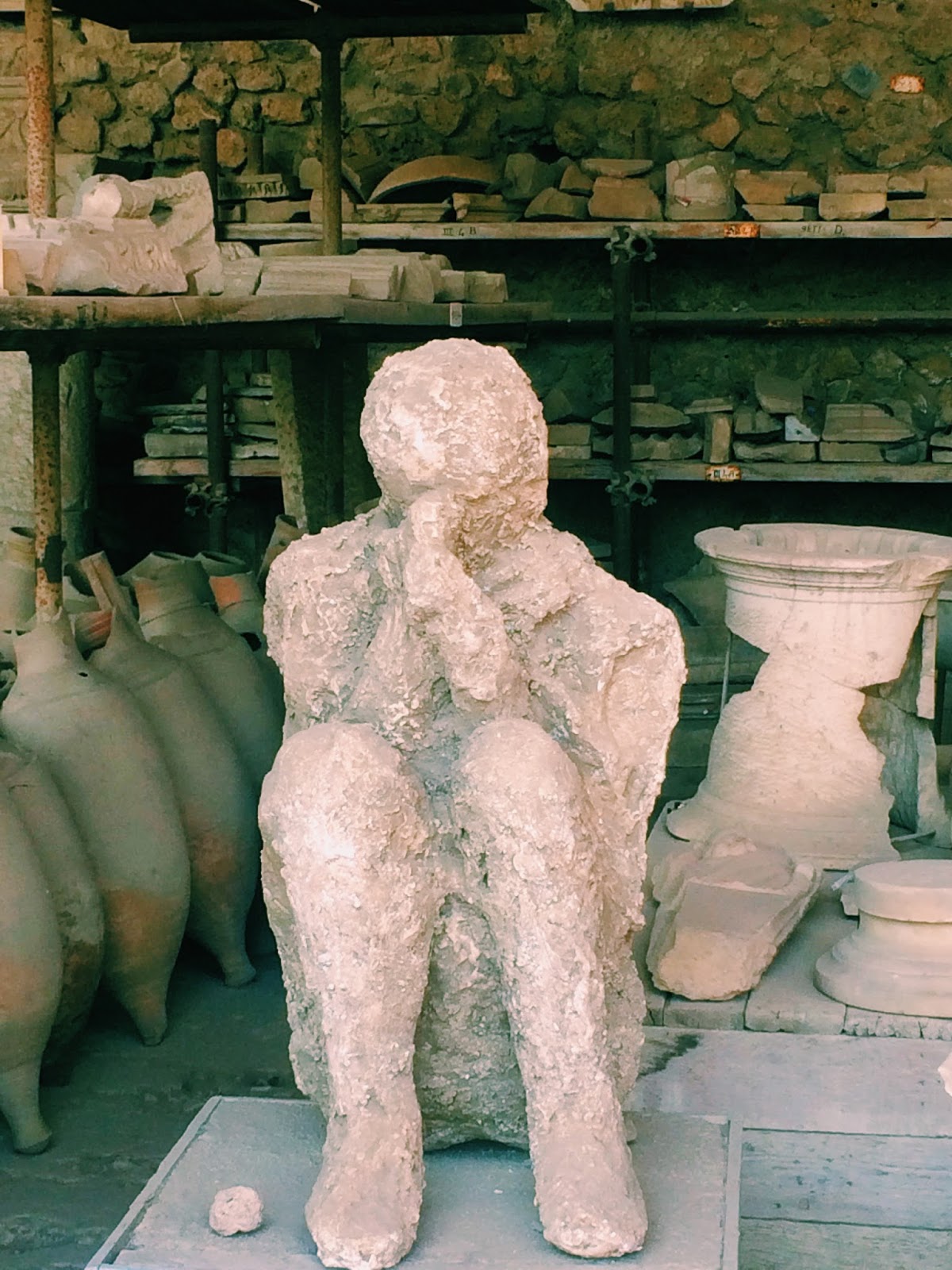
Most of the bodies were gone this trip, on loan to museums and Expo


I absolutely love going to Pompeii. Whenever possible I hire a local licensed guide. As often as I go there (several times per year with my tour groups) I still learn new things from my guide, every time. Pompeii is a live archaeological dig, so even if you have been before there are bound to be new things for you to see.

 Related Post: 8 Things You Must Do In Naples


18 Things You Probably Didn’t Know About Pompeii

1. In A.D 62 a massive earthquake severely damaged Pompeii. The city’s rebuild was getting its finishing touches when Mt. Vesuvius erupted in A.D 79

2. There were no wealthy areas in Pompeii – rich and poor lived side by side. The city was designed to allow all citizens to live in comfort, regardless of income or social standing.

Related Post: 10 Things To Do On The Amalfi Coast

3. There was free bread for all – no one went hungry in Pompeii. To ensure against popular discontent the powers decided on “Bread and Circuses” or bread and games for all. Not only could citizens live without worries about food, they also were given free entertainment in the form of gladiator fights, with events happening up to 100 days per year.

People had free time to do other things, including creating great art.


4. Pompeii had a clever 3 tiered water system. One tier took water into the wealthier private homes, giving them running water. A second fed water into the city for sanitation, and a third fed the fountains. If there was a drought or if water was running scarce they would shut off the tier to the private homes first, then the sanitation water second, so that there would still be the third channel running, keeping water available for everyone to drink.
The problem was there was no sewer system, so waste flowed down the streets.

Pompeii-Water-Fountains
Some of the water fountains in Pompeii are still working. You can refill your water bottles as you meander around.


5. There were 42 water fountains in Pompeii, ensuring that no citizen had to walk more than 1 minute from home to get fresh, cool water. Some of them are still working, enabling visitors to fill their water bottles while walking around.

Related Post: Discover The Greek Temples At Paestum 

6. The big homes had elaborate, huge bathrooms.

Taking long, relaxing baths was considered to be one of the greatest pleasures in life, and as such bathrooms were designed to be beautiful, with mosaic floors and frescoes walls.

Houses-in-Pompeii
Looking down a street in Pompeii.
In A.D. 79 there would have been bold colors painted on the houses, and lush foliage all around.


7. Houses were 2 stories, and we’re actually very well built.


8. Much is known about life in Pompeii through the graffiti on the walls. Paper was not widely available, so people would scratch messages into the walls with nails. Love notes, meetings, political aspirations, public announcements, missing persons notices, notes to neighbors, running bar tabs – all were perfectly preserved on the outdoor walls.


9. The citizens of Pompeii had no idea that Vesuvius was a volcano – it hadn’t erupted in 1800 years. Prior to the eruption there was no crater at the top of Vesuvius, instead it just looked like every other mountain in the area. Vesuvius had extremely fertile land which was well farmed, and had many communities living on it.

 Related Post: The Palace Of Caserta, Outside Naples

10. The wine shops/bars in Pompeii stayed open all night long.


11. There was 18 hours of pumice and ash raining down on Pompeii before the lava flowed.


12. This volcanic ash sealed bodies where they fell and then hardened, creating perfect human shaped forms. As the bodies decomposed they left hollow spaces in the hardened ash. Archeologists poured plaster into the hollows, creating casts that are so detailed you can see the moment of death in their faces.

13. Pompeii’s population was estimated to be between 15, 000.  It is estimated 2, 000 were killed. Which means most of the town’s people escaped in the days leading up to the eruption.

14. At the time of the eruption there was no word for volcano in latin.

15. Pompeii and it’s stretch of coastline were a popular resort area where wealthy Romans had their summer villas. The exuberant sex lives of the Romans, which were well documented in local art, lead the area to be known as the “Love Coast”. (I only recently read this last part, but if it is true, it’s pretty funny).

16. There were 40 bakeries in Pompeii, and by many accounts 30 brothels. This has been questioned however as any building with erotic art has been labeled a brothel.
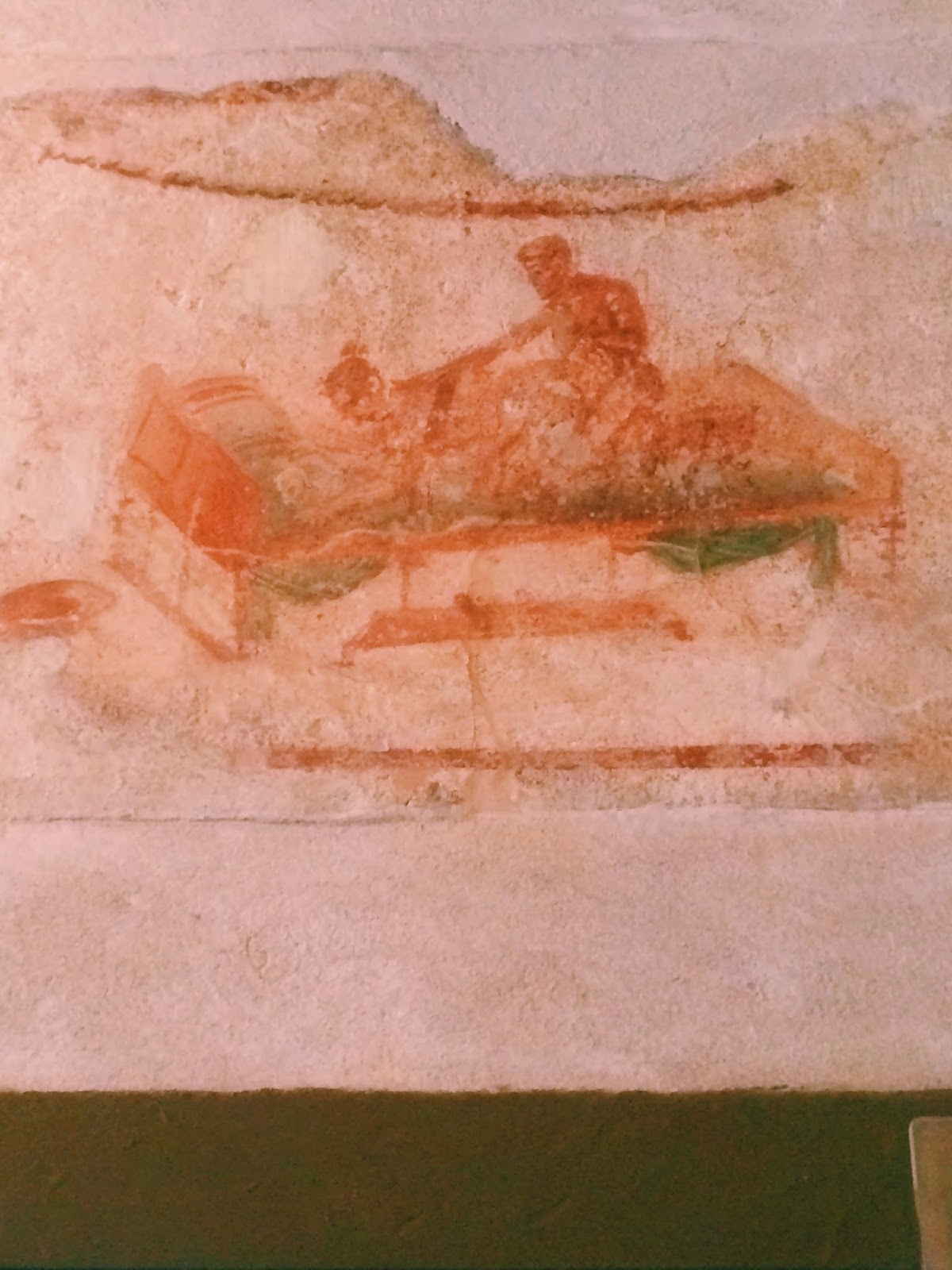
The main brothel was the Lupanare, which features paintings of the many different sexual positions available to customers.


Lupanare-Pompeii
On the menu at the Lupanare, Pompeii


17. Pompeii was full of erotic art.

18. In the 16th century letters written by Pliny the Younger were discovered, describing the eruption as viewed from across the bay at Misenum where he watched with his uncle, Pliny the Elder. These letters give us an in depth account of how the events of the day progressed, including Pliny The Elder’s attempt to rescue friends from the beach at Herculaneum, which ultimately led to his death.

Pompeii is a suburb of Naples and is easy to access by train. You can make a day trip from Rome, or visit for a few hours from Sorrento or Salerno on the Amalfi Coast.


Verified by ExactMetrics