
Why You Need To Visit The Baths of Diocletian In Rome

Are you traveling to Rome anytime soon? Do you want to see some fascinating sites, full of ancient history, but far from the tourist crowds? Guess what? Rome is full of amazing places that the tour buses don’t go to. Places you can wander around at leisure, experience ancient Rome without the crowds, and that are right in the heart of the city. Today I want to introduce you to one of these treasures.

Why You Need To Visit The Baths Of Diocletian In Rome

Personally, I find Diocletian fascinating.

Just between you and me I knew exactly nothing about him until I started googling his namesake public baths and pool. Partway down my never ending list of things to do in Rome was an entry for Diocletian’s Baths and I had decided to read up on Diocletian and then visit them on the next trip to the Eternal City.

It seems as though every emperor I research has something quirky or interesting going on…

About Diocletian

Anyway, old Diocletian was a Dalmatian military guy who rose to power towards the end of the Crisis of the Third Century. Said crisis was caused by invasions, civil war, economic depression and the plague. The reign of Diocletian stabilized the empire and ended the crisis.

Diocletian was emperor of Rome from 284 - 305 A.D. Although he never set foot in Rome, his co-emperor Maximian dedicated the massive Baths of Diocletian to him. These were the biggest public baths and pools in the Roman Empire

Diocletian, Emperor of Rome

Diocletian became Emperor in 284. He understood that the empire had become too huge and too far reaching to be successfully governed by just one person, so in 286 he made Maximian his co-emperor. He ran the Eastern Empire himself and had Max take care of the west. It is thought that Diocletian never set foot in Rome.

The empire had had a revolving door of emperors, some only lasting weeks or months, others just a few years. In order to ensure smooth succession for themselves and for future emperors, they created a system whereby two competent, experienced administrators would be in place as “junior emperors”, learning how to run the empire so that when the time came the transition would be seamless. (Greed and power hunger meant this would be short lived, even though it was a brilliant idea)

He reformed and restructured the government, essentially keeping it intact for the next 150 years. It had been on the verge of collapse during his youth. Diocletian was an important emperor.

A Life With Vegetables

All went well until 305 when in poor health Diocletian decided to become the first emperor to abdicate. He moved back to the Dalmatian Coast and retired to a palace in a Croatian town now known as Split, living out the rest of his life growing vegetables. Years after his abdication when his system of co-emperors and junior emperors collapsed and the empire returned to chaos, Rome asked him to come back, be emperor again and fix everything, but he was happy with his tomatoes and cabbages (or whatever vegetables he was growing) and chose to stay in Croatia.

RELATED POST: 10 THINGS YOU ABSOLUTELY MUST DO IN ROME

The Baths

Emperors left their mark on the empire by building structures designed to last the test of time. The third century was to a degree a building wasteland, so it was time for something huge to be built.

Maximian was co-emperor of Rome. Diocletian ruled the Eastern empire and Maximian ruled the western empire. Maximian commissioned the Baths of Diocletian, named for an emperor who never set foot in Rome

Maximian, co-emperor of Rome

And so the Baths of Diocletian, the largest of all the imperial baths in the Roman world, was commissioned. They were actually commissioned by co-emperor Maximian in 298 and completed in 306, by which time neither were still emperor. Maximian named them the Baths of Diocletian. Diocletian himself never saw them, as he didn’t go to Rome.

The Baths of Diocletian are not just huge, they are gargantuan. They take up 130,000 meters (or 32 acres) between the Viminal and Quirinal Hills. They were designed to be public baths/pools for the people living in the Viminal, Quirinal and Esquiline quarters of the city.

Supposedly large enough to accommodate 3000 people at any time, the complex was made up of a cool water pool (frigidarium), and medium temperature pool (tepidarium) and a hot pool (caldarium) as well as a 4000 square meter outdoor pool. There was an open air gym (palaestra) on either side of the pools, as well as libraries and beautiful walkways.

Today the ruins of the baths are still enormous. As you walk through the ruins the size and scope of the project is quite overwhelming. You can almost hear the patter of Roman sandals ambling through the common areas nearly 2 millennia ago. How incredible it must have been for the people of Rome to stroll these giant walkways on their way to the pools, how sensational the beauty must have been!

For two centuries water was supplied to the pools via the Aqua Marcia aqueduct, until the siege of Rome in 537 when Ostrogothic king Vitiges had the water supply cut off.

If the shell of the building and the pools were all there was to see I would recommend you add this stop to your Rome itinerary, but there is more.

RELATED POST: PIAZZA NAVONA – 14 FACTS YOU NEED TO KNOW ABOUT ROME’S LOVELIEST PIAZZA

The Statues

Statue at the Baths of Diocletian in Rome. Statues here date from the 1st century B.C. to the 4th century A.D.

Throughout the complex, everywhere you turn there are statues.

Statue at the Baths of Diocletian in Rome. Statues here date from the 1st century B.C. to the 4th century A.D.

Spectacular, awe inspiring statues of Gods and Kings, beasts and beauties. Statues and artifacts that will take your breath away.

Statue of a water nymph from a 2nd century fountain. Found at the Baths of Diocletian in Rome

Water nymph from a fountain, dating back to the 2nd century

Sometimes I think they just dig up so many treasures in Rome that there is no place to put them. The Baths of Diocletian are as good a place as any to line up endless treasures from antiquity!

Walking through the cloisters looking at them all lined up throughout the inner courtyard was just incredible.

Cloisters at the Baths of Diocletian in Rome

Statues line the cloisters of this inner courtyard at the Baths of Diocletian

Some date back to the 1st century B.C. Plenty are dated to the 1st century A.D.
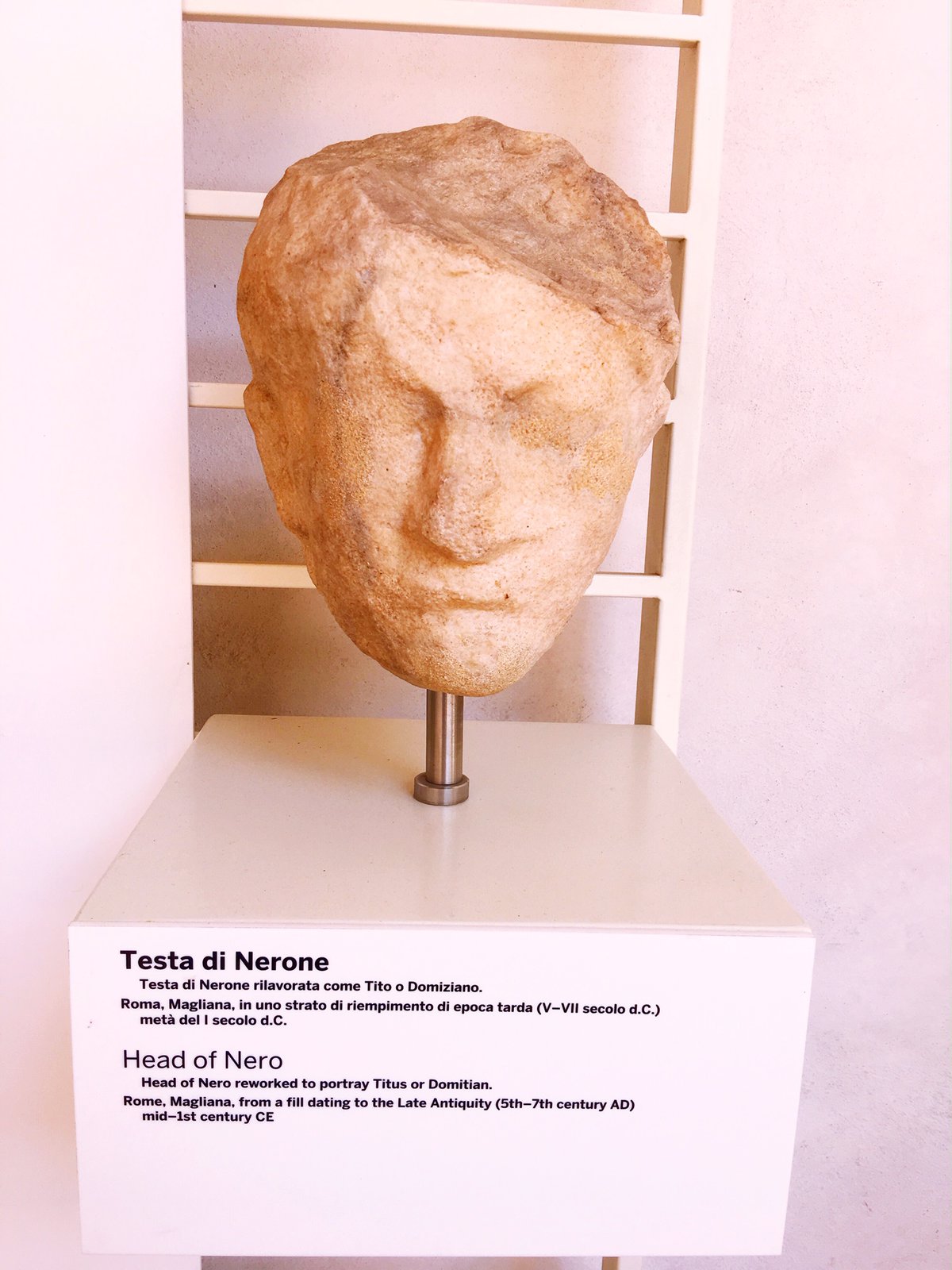
Bust of Nero from the 1st century A.D, at the Baths of Diocletian in Rome

From Nero’s head to a bust of beautiful Antonia Minor, mother of Emperor Claudius, dated to around 18 A.D, that stands taller than me.

Bust of Antonia Minor, mother of Emperor Claudius, dated to 18 A.D. This statue is at the Baths of Diocletian in Rome

Statue of Antonia Minor, mother of Emperor Claudius, 18 A.D.

Sarcophagi from 160 A.D, water nymphs from 2nd century fountains – there is just so much here to look at!

the details on this 4th century sarcophagus are amazing. 1700 years later the eyes and noses and facial expressions are all still there. You can see it at the Baths of Diocletian in Rome

I actually spent a small amount of time exploring the pools and an enormous amount of time walking around and around all the areas with statues.

Statue at the Baths of Diocletian in Rome. Statues here date from the 1st century B.C. to the 4th century A.D.

And here is what is even more fascinating: once again I had the whole place almost entirely to myself.

Statues lining the cloisters at the Baths of Diocletian in Rome

My first trip to the Baths of Diocletian was in June of 2018. That day Rome was packed to bursting point and stifling hot. I had initially been going to tackle some items on my list that were close to the Colosseum but the crush of tourist humans in the area forced me to head back out of there as fast as I could.

On the map Diocletian’s Baths didn’t look far so I decided to walk, which wasn’t an entirely brilliant idea on a day so hot and humid. A taxi would have only cost a few euros and buses run right up to the Piazza della Repubblica which abuts parts of the walls.

The entry is beautiful, with trees and a huge fountain, a lovely place to escape the heat, or if not visiting during the middle of summer just a lovely place to sit and enjoy the scenery.

The cost of entry was around 10 euros and was worth every penny. There were other people visiting that afternoon – I wasn’t the only one, but I might as well have been. Everywhere I walked I had a clear, uninterrupted view. I could look at the statues from every angle, I could see it all unimpeded.

Inner courtyard at the Baths of Diocletian in Rome

Statues line the walls under these cloistered porticos. It was a busy day in Rome, but there was no one here

I think my favorite part was walking round and round the cloistered internal courtyard, cool and shaded from the heat of the day. A few artists were scattered around sketching, but when I look at all the photos and videos I took, I can’t even see them.

This, to me, is part of the incredible magic of Rome. There is so much to see and do, most of which is far from the tourist crush.

RELATED POST: 10 FABULOUS DAY TRIPS FROM ROME BY TRAIN

What else is there?

Diocletian was said to be the most ardent persecutor of Christians. He killed more of them than any other emperor. I have read that the Baths of Diocletian were built by 10,000 Christians. Whether that number is true or not, suffice to say it was a rough time to be a Christian.

This wasn’t based on theology so much as it was based on continuity, obedience and legitimacy. Emperors presented themselves as semi-divine, almost Gods. The concept of aligning yourself with the “one true God” was a direct challenge to that legitimacy. The current system had worked so well and Romans had successfully worshipped their Gods for 1000 years. Why change?

In the end the Christians got the last laugh. Pope Pius IV commissioned Michelangelo to build a church on the site to commemorate the Christians who died building the baths. Santa Maria degli Angeli e dei Martiri was built using the frigidarium and tepidarium structures, and a small cloister was built using part of the natation (outdoor pool). St Mary of the Angels and Martyrs is a must see while in the area.

A second church is also there, San Bernardo alle Terme (St Bernard of the Baths). This one was built in 1598 and is quite remarkable in its own right. Similar to the shape of the Pantheon this church is cylindrical, has a dome and an oculus. There are statues of 8 saints in wall niches, by Camillo Mariani dating to around 1600.

You could spend a fabulous afternoon exploring the Baths and the 2 churches. As with so much of Rome you are away from the crowds while still in the heart of the city.


How to get there:

Take a bus from any direction to the Piazza della Repubblica.

From the Colosseum/Forum area it is an easy walk up the Via Nazionale.

For more fantastic things to see and do in Rome, check out my internationally best-selling book Glam Italia! 101 Fabulous Things To Do In Rome. Discover the most amazing places, hiding in plain sight right under your nose! Almost everything in this book is within a 20 minute walk from the heart of the historic center, and close to where you will be anyway. They get very few tourists, so you can avoid the crowds and enjoy a secret side of this fabulous city!

Get your copy at Amazon.com


Bonus Content

One of the most fabulous things to do in Rome is to enjoy an early evening aperitivo with a view. My Best Rooftop Bars in Rome pdf tells you where they are, what you see and why you need to add at least one of them to your Rome itinerary! Get your copy of The Best Rooftop Bars In Rome HERE


The Best Sandals To Wear In Europe This Summer

I have written about which shoes are best to wear in Europe before. I wrote about the best summer shoes  and also about winter shoes to wear in Europe, both of which I will re-link at the bottom of this post. A series of events happened last week that made me decide to write a post about the best pair of sandals I have ever worn in Europe.

This is not a sponsored post. This post does contain affiliate links

Venice Grand Canal

My sandals in Venice in June 2017

I wore the same pair of sandals everyday in Europe last summer on my May/June Glam Italia Tours, I wore them half the time in Paris in September (I wore these Adidas sneakers the days I didn’t wear my sandals), and then I wore them every day for a month this past June on this year’s Glam Italia Tours.

Portofino Italy

June 2017 in Portofino Italy

A Confluence Of Events.

1. My week started with an email from one of my blog readers. She was in Florence and had been doing everything on the list from my 10 Things You Absolutely Must Do In Florence blog post. She was super excited about it all  and ended her email with “oh by the way, I got those Sofft sandals that you, and you’re right – they are the most comfortable shoes ever!”

2. Then when I was looking through my photos from Venice trying to find something to put in my Don’t Be A Tourist In Venice post I kept noticing my sandals in every photo that showed my feet.

3. Finally, I was scrolling through the notes on my phone and found a page where I had bee keeping a total of the steps and the flights of stairs I was doing each day in Italy. I was pretty wowed at just how many miles I walk on my tours, and more wowed that these shoes not only didn’t fall apart, but are still going strong!

Burano Island

Walking in Burano, Venice in my Sofft Mirabelle sandals, June 2018

Which Sandal Is It??

This is the sandal in question. It is the Mirabelle by Sofft. Here is the affiliate link: sofftshoe.com sandals page


Why Do I Love This Sandal?

So here is what I love about this sandal:

*It is unbelievably comfortable. If you have been to Europe before than you already know that you spend your days walking and walking, so you need a good cushy sole to not only protect your foot but also to cushion the pressure on your lower back. Also you are walking on cobble-stoned streets and uneven surfaces, both of which put extra hardship on both your feet and your shoes.

*It takes zero breaking in – the leather is super soft but still good and strong. No blisters, no rubbing, no hurting your feet, yet at the same time offering really great support. You can put the Sofft Mirabelle on straight out of the box and walk all day long with no problems at all.

* It goes with everything. My rule is only 3 pairs of shoes can go with me on a trip, which means I need shoes and sandals that can work with everything I am going to wear. I have the Mirabelle in the color pictured above which is called Luggage.

*It is well made. This sandal is really well made. Even with the non-stop walking up and down hills and the average of 25,000 steps per day, the sole hasn’t pulled apart, the sandal hasn’t ripped and it hasn’t lost its shape.

Shop Sofftshoe Site today!

Paris book stalls along Seine

Walking along the left bank in Paris in the 6th arrondissement. Sometime in 2017

So How Many Miles Have My Sofft Mirabelles Done?

This blew my mind! In 2017 my Sofft Mirabelle sandals did 3 Glam Italia Tours and two Glam Paris Tours. In Paris I wore them half the time on one tour and every day on the other.

Paris, Montmartre

Montmartre, Paris, sometime in 2017

In 2018 they have done two Glam Italia Tours.

I also wear them at home in Phoenix on photoshoots, commercials, ad campaigns, music videos and other long days when I am shooting in studios with concrete floors.

I haven’t kept track of the steps I do here in Phoenix each day but in Europe I am always keeping an eye on it.

In June 2018 on my Glam Italia Tours I walked 158 miles total. So that is about 79 miles per tour, give or take. (I have 2 days in between each tour, arrive 2 days before the tours start and stay on for a few days after they are over. I walk and walk all day long on these days, checking out new places and seeing new things).

Mirabelle by Sofft

Florence, 2017

Working with that average and adding in 3 Glam Italia Tours in 2017, that’s another 237 miles in Italy alone, without factoring in my Paris tours.

Just adding the Italy numbers that’s 395 miles!!! Put into perspective the distance from Phoenix to Los Angeles is 360 miles.

Piazza San Marco, Venice. June 2018

How many pairs of shoes do you own that could walk from Phoenix to L.A. and still keep going strong??

How Do You Keep The Soles White?

One of my friends turned me onto this cool trick. When soles are looking scuffed and dirty you can clean them back to nearly new by using a little bit of bathroom cleaner or Mr Clean and a cloth or rag. If you have a Mr Clean Magic Eraser handy that works brilliantly too. I don’t clean mine while I’m away, but when I get home they really need it.

I wish I knew someone at Sofft Shoes to show this to – they should be sponsoring  my tours! Or something. Maybe they should be sending me free shoes – none of which is happening by the way. But I do think that at more than 395 miles these sandals probably are the best value for money I have ever had.

Sofftshoe.com offers free shipping on all orders, easy returns, and free exchanges.
Chances are you won’t be putting your sandals through the hard work I put mine through, but regardless, these are a great buy!

RELATED POST: THE BEST SHOES AND SANDALS TO WEAR IN EUROPE THIS SUMMER

RELATED POST: CHIC AND COMFORTABLE SHOES TO WEAR IN EUROPE THIS WINTER

Traveling To Europe? You Need To Know About This Scam!

I have heard multiple times already this year about a new-ish scam that is running in Italy and across Europe. I haven’t encountered this one yet myself but it sounds like it is going to be everywhere this summer. Originally I planned to send this a an email to the travelers on my upcoming Glam Italia Tours, but as so many of you will also be heading to Europe this summer I want you to be aware too.

Scams To Be Aware Of In Europe

Any place that has lots of tourists is going to have its share of scammers and petty thieves hoping to separate them from their valuables.

The following are three scams you need to be watching out for, number three is the new one.

1. Be Wary Of Beggars

Just as we have homeless people panhandling here in the USA, in Europe you will see beggars, especially around big tourist attractions. In Italy you will see them around the big churches and cathedrals, in Paris you see many more, and they seem to be on the streets in the busy areas.

I will happily buy food for the hungry, and do it all the time, but when it comes to beggars in Europe I generally keep my distance. I am there often enough to see the same faces working the same places, year in and year out.

You will see gypsy women on their knees in the gutter, crying and begging for money. Look a little closer and you will see they’re not thin or starving, in fact plenty of them are chunkier than I am! Often (but not always) they work in teams. Their partners are watching from across the street or somewhere nearby to see where you pull your money from, and what valuables are on your wrists and fingers. A few minutes later they bump into you or distract you, and before you know it your wallet is gone, your watch is gone or whatever they wanted is gone.

As much as you want to be compassionate, don’t be.

RELATED POST: 11 CREDIT CARD TIPS FOR INTERNATIONAL TRAVEL

2. The Ring Scam

This one has been happening in Paris forever, but last year while there I finally was able to see it in action. I let it keep going for ages just because I was so entertained, but I seriously advise you to walk away and not engage should this happen to you.

The way it works is the scammer will pretend to find a ring on the ground not far from you. They will politely ask if you dropped it or if it is yours. As they look at it they will tell you it has an inscription, normally something to do with how many carats gold it is.

If you let them keep talking they will tell you they don’t have papers to be in the country so can’t turn it in or sell it, and then they try to convince you to buy it from them.

Remember if you let these people get physically close to you chances are they will rob you without you being even slightly aware of what is going on. And of course, do not even think about buying the ring! It is a fake, and on top of that you are showing them where your money is.

I haven’t been aware of this scam in Italy, but then again after a lifetime of going back and forth to Paris, last summer was the first time I actually saw it there, so who knows?

RELATED POST: SHOULD YOU BUY TRAVEL  INSURANCE?

3. The Bracelet Scam

This one is happening in Italy at the moment. I have seen it discussed on some of the Facebook groups and travel forums I belong to several times already this year. So far travelers have been in Florence and in Milan when this has happened, but it no doubt happens elsewhere too.

A man or woman stops you and asks you the time or for directions, (or for whatever they can get you to stop for) then they grab your wrist and tie a bracelet onto it. As soon as it is tied they start demanding money for it. Travelers have reported being followed down the street, and one reported being threatened. Aparently the scammers are quite aggressive.

Should this happen to you, yell at the top of your voice. They figure that you will quietly acquiesce and they will get away with it. If you make a lot of noise other people will stop and any police in the area will come (if they hear you). The last thing a scammer wants is the attention of a crowd or of the police, so make as much noise as you can.

While you are traveling you need to be aware of pickpockets and scammers. If someone approaches you, don’t stop to speak to them. Scammers are banking on you being naïve, gullible and unaware. They plan on you thinking it would be rude not to stop and acknowledge them.

The ladies traveling with me are pretty much safe, because I think, scammers can smell the fierceness of a firey redhead coming their way and won’t waste their time with the significant trouble on the immediate horizon (me) when there are plenty of unsuspecting tourists to pick on.

That being said, I will be telling my travelers exactly what I am telling you:

*Keep your handbag closed at all times. If your bag has a flap closure wear the flap side against your body.

*Always keep your hand on your bag.

*Guys, don’t put your wallet in your back pocket.

*Don’t stop and talk to people who approach you– if someone needs to know the time or needs directions there are plenty of other people they can ask. An Italian is not going to stop a tourist – they will ask another Italian. If someone is approaching you, trying to get your attention or trying to talk to you, ignore them and keep moving.

The best way to avoid pickpockets, gypsies et al is to be aware. Know they are out there but that they are looking for easy pickings. When you look like you are aware of your surroundings and your belongings you are less enticing. Don’t hang your handbag on your chair, don’t put your bag or your camera down and turn your back on them, don’t flash money around.

Before you let yourself get panicked, remember that here in the USA the bad guys have guns. In Italy and across Europe they don’t.


728 x 90 Orbitz Lost Stolen Passport


Verified by ExactMetrics